The dark web sounds like something out of a movie. You have heard the term on the news, maybe from a security company promising to "monitor the dark web" for you, and it conjures images of shadowy hackers in basements. That mystery is part of the problem, because when something feels murky and technical, it is easy to either panic about it or tune it out entirely. Neither helps you.
So let me pull back the curtain and explain it plainly, the way I wish someone would for every business owner. What the dark web actually is, how your business information could end up there, and most importantly, what that means for you and what you can actually do about it. No mystery, no hype, just a clear picture and a practical response.
What the dark web actually is
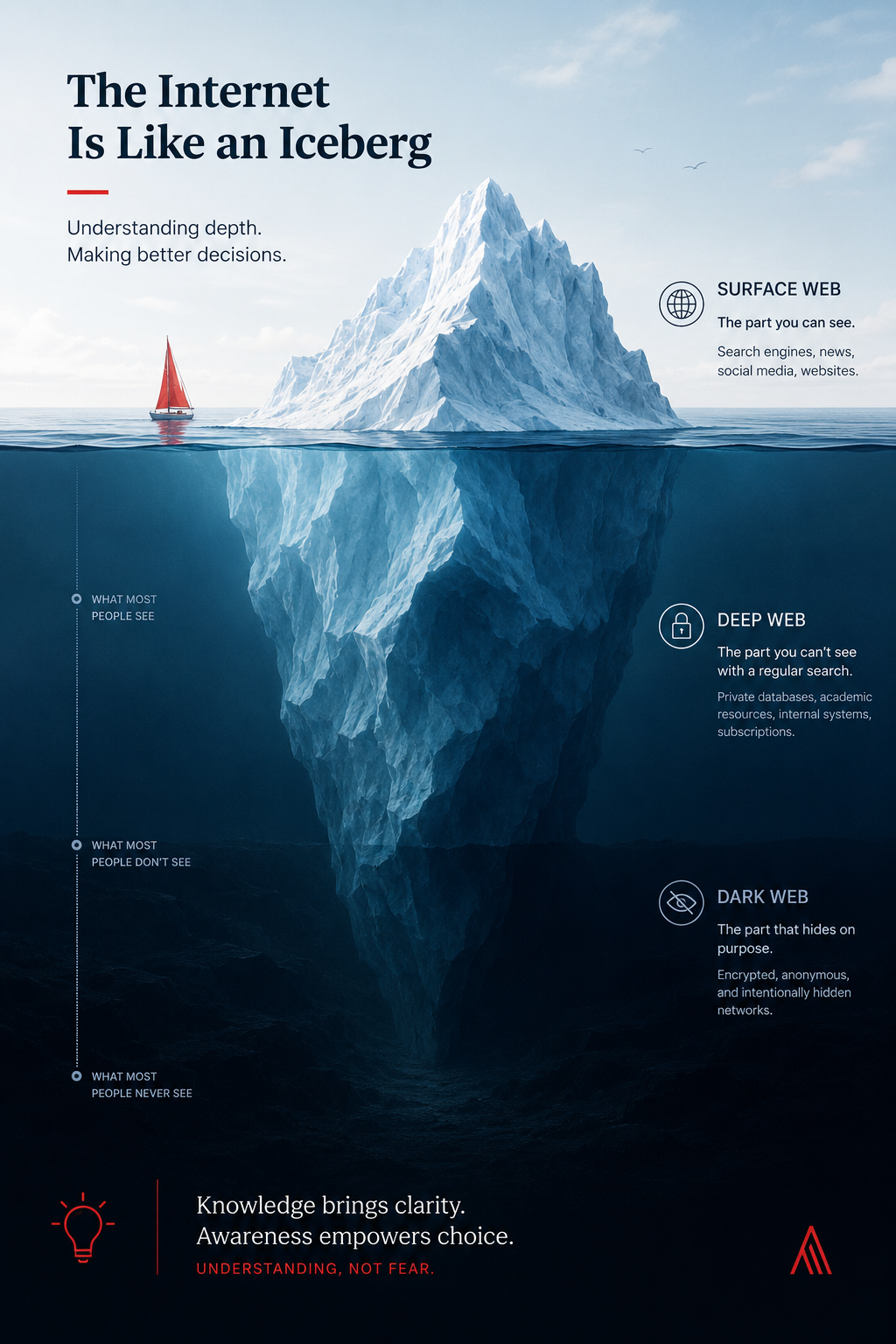
Think of the internet in three layers. The first is the part you use every day, the websites you can find through a normal search, your bank, the news, online stores. That is the surface web. Below that is a much larger layer of content that exists online but is not meant to be publicly searchable: things behind logins, private databases, your online banking once you sign in, internal company systems. That is sometimes called the deep web, and most of it is completely ordinary and legitimate.
The dark web is a small, deliberately hidden corner that requires special software to reach and is built for anonymity. That anonymity has some legitimate uses, but it also makes the dark web a marketplace for illegal activity, and that is the part that matters to you. Among the things bought and sold there is stolen data: leaked passwords, breached customer records, payment information, and login credentials, often packaged up and sold in bulk after a company gets breached.
In plain terms: when data gets stolen, the dark web is frequently where it goes to be traded. It is the criminal flea market for information that was never supposed to leave the businesses and people it belonged to.
How your business information could end up there
Here is the part owners do not always connect. Your business data can end up on the dark web without anyone ever breaking into your business directly. It usually arrives by one of a few routes.
The most common is a breach somewhere else. Remember that you and your employees have accounts on dozens of outside services, and when one of those companies gets breached, the email addresses and passwords in it can end up for sale. If you or your team reused those passwords, that leaked credential is now a working key to your business accounts, sitting in a marketplace for criminals to buy and try.
Another route is a direct breach of your business, where an attacker steals your customer records or data and sells it. And another is your information being swept up in one of the massive combined collections of leaked data that circulate, billions of records pooled from countless breaches over the years.
The unsettling reality is that for most people and businesses that have been online for a while, some information, often an old email and password combination, is already out there. That is not a reason to panic. It is a reason to understand what it means and respond sensibly.
What it actually means for you (and what it doesn't)
Let me put this risk in proportion, because the goal is clarity, not fear. The fact that an old password of yours might be floating around on the dark web does not mean your business is currently being robbed. What it means is that a key to one of your doors may be in circulation, and the danger depends entirely on whether that key still works and whether that door has a second lock.
This is exactly why two protections we talk about constantly matter so much. If a leaked password is unique to one account and you have since changed it, its value to a criminal is small. And if every important account is protected by multi-factor authentication, then even a current, working password is not enough to get in on its own. The dark web is full of stolen keys. Your job is simply to make sure those keys do not fit your locks, or do not work alone.
So the existence of your data on the dark web is a prompt, not a verdict. It tells you to make sure your protections are current, not that disaster is upon you.
What you can actually do
Here is the practical response, and it is reassuringly familiar, because good security is consistent.
- Assume some of your information is already out there, and protect accordingly. Make your important passwords long and unique, ideally with a password manager, so a leaked password from one place cannot be reused against your other accounts. Turn on multi-factor authentication everywhere it matters, so a stolen password alone is useless. These two steps neutralize most of the danger that dark web data represents.
- You can also check known breaches. Reputable free tools let you enter an email address and see whether it has appeared in known data breaches, which is a useful prompt to change any still-in-use passwords tied to it. A safety reminder: only ever enter your email address into such a tool, never your password.
- And this is where dark web monitoring comes in, the service you may have heard offered. It is a tool that watches dark web marketplaces and data dumps for your business's information, your domains, your accounts, your data, and alerts you when something shows up. The value is early warning: knowing that a credential or record has been exposed so you can change passwords and respond before a criminal makes use of it. It does not remove your data from the dark web, nothing really can, but it turns an invisible exposure into something you can see and act on.
How we think about it
Demystifying threats like this and turning them into manageable action is the whole idea behind how we work at Red Door Shield, through a simple framework we call KIT: Keep, Inspect, Trust. Keep what is valuable secure, with the strong unique passwords and multi-factor authentication that make leaked credentials worthless. Inspect what is coming in, which includes watching for your information surfacing where it should not, so exposure becomes an early warning instead of a nasty surprise. And trust through validation, verifying rather than assuming. The dark web is not a boogeyman once you understand it. It is just one more place stolen keys are traded, and the response is the same solid fundamentals, plus knowing when your information has turned up.
What ready looks like
Picture hearing "your data might be on the dark web" and feeling informed rather than afraid, because you know exactly what it means and you have already handled the risk: unique passwords so a leak does not cascade, multi-factor authentication so a stolen key does not work alone, and monitoring so you would get an early warning if something surfaced. The mystery is gone, and so is most of the danger.
That is what ready feels like. Not fearing a hidden corner of the internet you cannot see, but making sure that whatever is traded there cannot actually open your doors.
The dark web is real, but it is not magic, and it is not a reason to panic. It is a reason to do the fundamentals well and to know when your information has been exposed. If you want to find out whether your business's information is showing up where it should not, and make sure your protections would hold even if it has, that is a conversation worth having today.
Learn how to check if your password was stolen, read about why password managers are safe, or see how to turn on multi-factor authentication.
Know Where Your Business Stands
Our free Business Security Assessment gives you a clear picture of your current security posture in less than 10 minutes. No technical knowledge required.
Not sure where your business actually stands?
Take our free Business Security Assessment. In under 10 minutes, you will know exactly where your gaps are and what it would take to close them.
Get My Free Security Assessment