I am going to make a claim that sounds dramatic and is almost certainly true for you: at least one of your passwords is already sitting in a database that criminals can buy. Not because you did anything wrong. Because some website you used years ago got breached, your login was scooped up with millions of others, and it has been quietly circulating ever since.
Here is the good news. You can find out in about two minutes, for free, right now. And once you see it for yourself, the steps to protect your business are simple. This is one of those rare security articles you can actually act on before you finish reading it. So let me show you how.
Why this is almost certainly already true
Over the past decade, an enormous number of companies have been breached: retailers, social networks, software services, all of them holding login information. When that happens, the email addresses and passwords inside end up collected, combined, and traded among criminals. These collections now hold billions of records. If you have used the internet for more than a few years, the odds that you are in one of them are very high.
By itself, an old leaked password might sound harmless. The danger is a habit almost everyone has: reusing the same password, or small variations of it, across many accounts. Criminals know this. So they take a password leaked from one forgotten website and try it everywhere that matters, your email, your bank, your business systems. This is called credential stuffing, and it is automated, fast, and cheap. One old leak becomes a master key.
For a business owner, the account that matters most is usually email, because email is the recovery point for everything else. Get into your email and an attacker can reset passwords across your entire digital life. That is why a stale, reused password is not a small problem. It is the most common way small businesses get compromised.
Do this now: check in two minutes
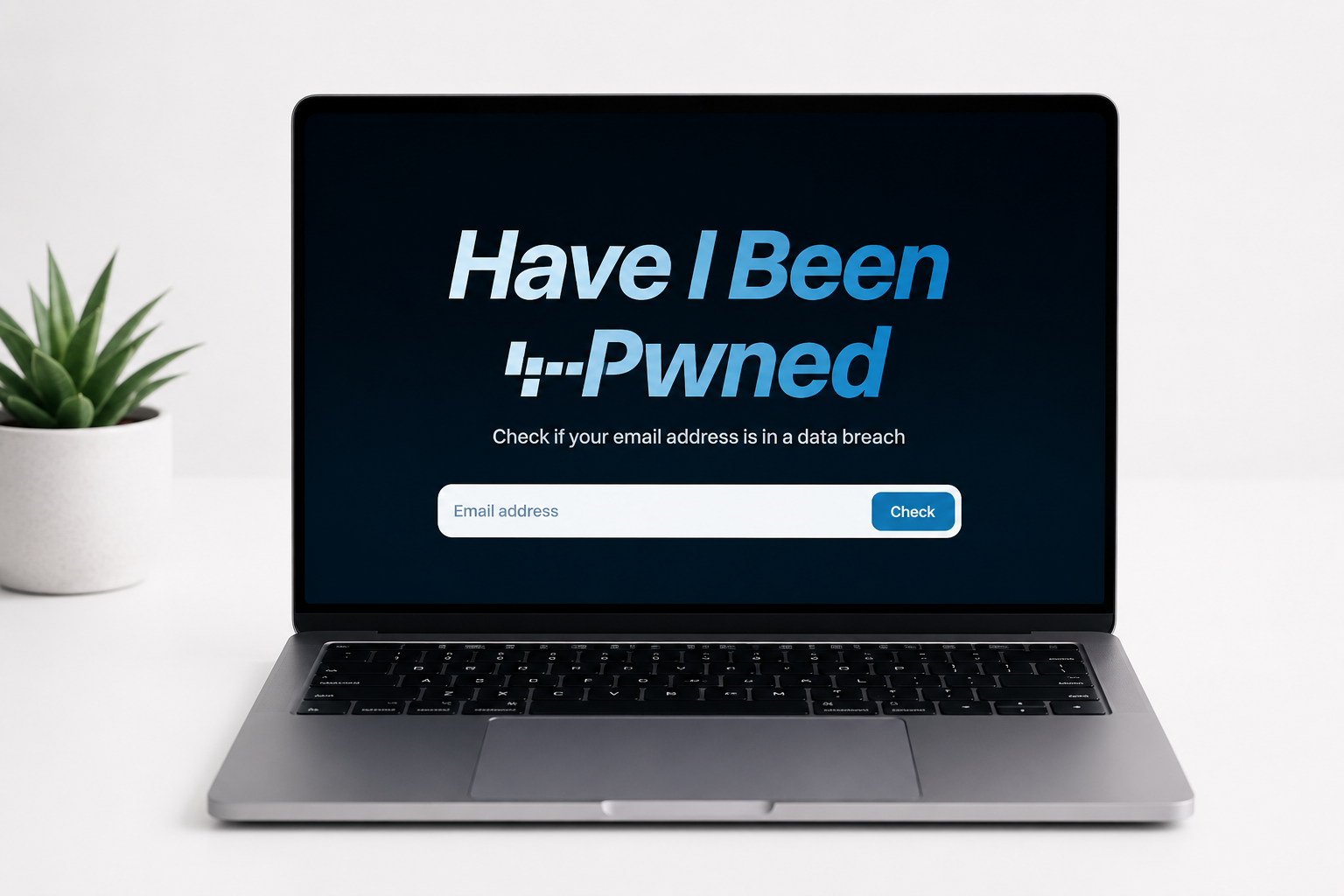
Here is the part you can do immediately. There is a well-known, free, and reputable service called Have I Been Pwned, run by a respected security researcher, that lets you check whether your email address has appeared in known data breaches.
Go to haveibeenpwned.com, type in your email address, and look at the results. It will show you which breaches your address has turned up in. Do the same for your work email and any address you use for business accounts.
One important safety rule while you do this. Only ever enter your email address, never your password, into a site like this. A legitimate breach-check service asks for your email so it can look it up. No trustworthy site needs you to type in your actual password to check it. If anything ever asks you to do that, close the tab.
Most people are surprised by what they find. Several breaches is normal. Seeing a familiar service on the list is the moment this stops being abstract and starts being real. Sit with that for a second, because that realization is exactly what makes the next part worth doing today.
Then do these three things today
Finding out is only useful if you act on it. Here are the three moves that turn the worry into protection, and you can start all three this afternoon.
1. Turn on multi-factor authentication, starting with email.
Multi-factor authentication is the extra code your phone receives when you log in. It means that even if a criminal has your leaked password, they still cannot get in without your phone. This is the single most powerful thing you can do, it is usually free, and it directly neutralizes the exact threat you just discovered. Start with your email, then your bank, then anything that touches money or client data.
2. Change reused passwords, beginning with the important accounts.
You do not have to fix every account tonight. Start with email, banking, and your core business systems. Give each one a strong, unique password that you do not use anywhere else. The goal is to break the master-key problem, so that one leak can never again unlock the rest of your life.
3. Get a password manager so you never have to remember them.
The reason people reuse passwords is that no one can remember dozens of strong, unique ones. A password manager solves that. It creates and stores a different strong password for every account, so the only thing you have to remember is one master password. It removes the human limitation instead of asking you to overcome it.
Those three steps, done together, close the door that leaked passwords walk through. You can make real progress before dinner.
How we think about it
This is the foundation of how we protect businesses at Red Door Shield, through a simple framework we call KIT: Keep, Inspect, Trust. The steps above are the K, keep what is valuable secure: lock the door, set the alarm, make sure a stolen password alone is not enough to get in. For a single owner, doing this by hand is very doable. For a business with a team, the challenge is making sure it is true for everyone, everywhere, all the time, which is the part we handle so it does not fall on you to police.
What ready looks like
Imagine knowing, not hoping, that even if one of your passwords leaks tomorrow, it does not matter, because no single password can open your accounts on its own. Imagine your team protected the same way, automatically. The background worry about that old password you have used for years simply goes away, because you handled it.
That is what ready feels like. Not the impossible goal of never appearing in a breach, but the achievable one of making those breaches harmless to you. You move from "I hope no one ever guesses my password" to "it would not matter if they did."
You just learned something real about your own exposure. The best thing you can do with that is act on it today, while it is fresh. Turn on multi-factor authentication for your email before you close this tab. That one step, right now, is a genuine win. And if you want to know how exposed your whole business is, beyond your own logins, that is a conversation worth having while you are already thinking about it.
Review our 8-point cybersecurity checklist or learn more about what happens after a data breach and AI voice scams.
Know Where Your Business Stands
Our free Business Security Assessment gives you a clear picture of your current security posture in less than 10 minutes. No technical knowledge required. No jargon. Just honest answers.
Not sure where your business actually stands?
Take our free Business Security Assessment. In under 10 minutes, you will know exactly where your gaps are and what it would take to close them.
Get My Free Security Assessment