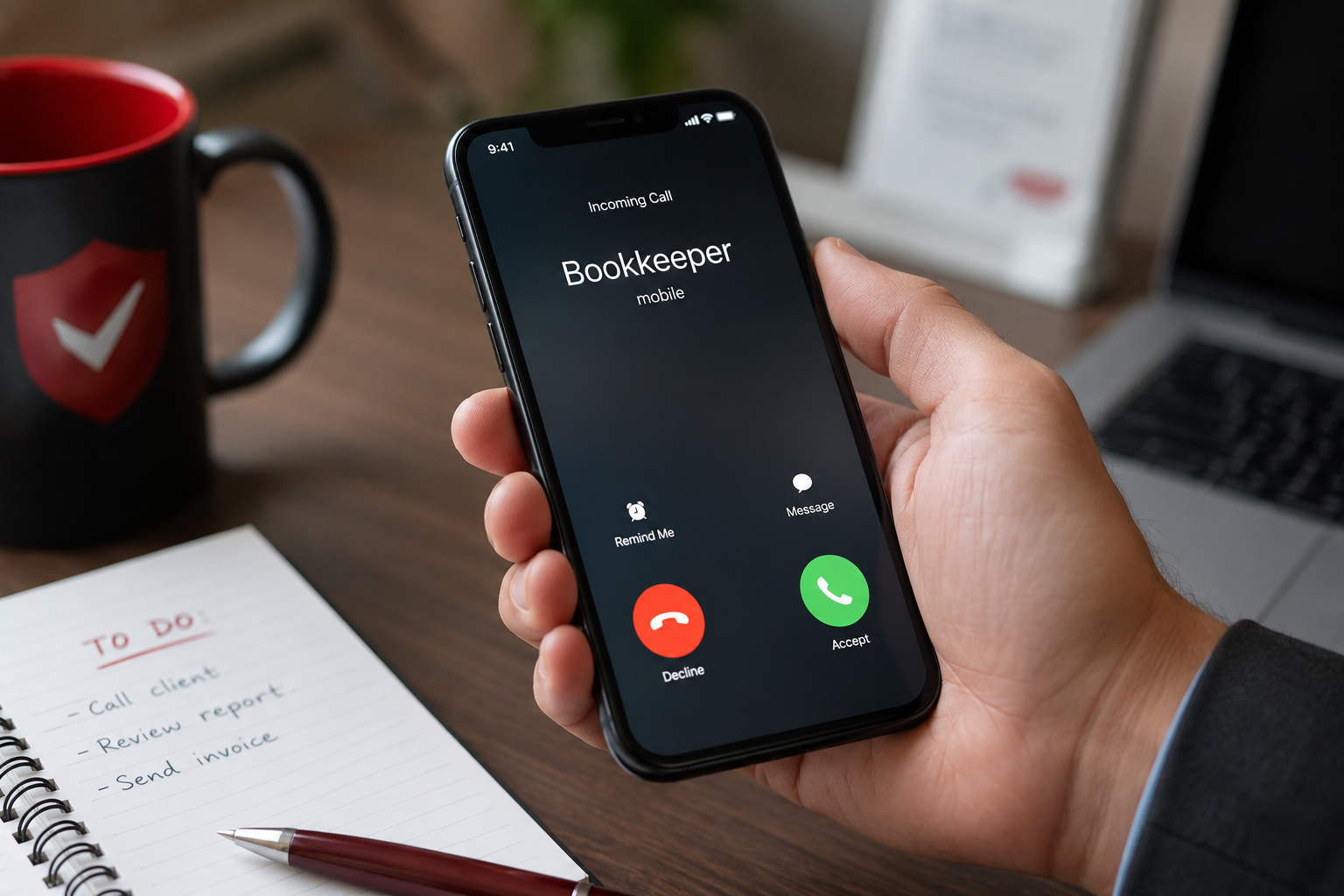
The voicemail sounded exactly like her. Same warm tone, same way she ran her sentences together when she was in a hurry.
A business owner I know listened to it twice. It was his longtime client, asking him to update the bank details on her account before the next payment went out. There was no reason to doubt it. He had heard that voice on the phone for years.
It was not her. It was a machine that had learned to talk like her from a few seconds of audio scraped off a webinar she had recorded months earlier. The voice was a copy. The bank account was a criminal's. And the only thing standing between that business and a five-figure loss was whether he happened to pick up the phone and call the number he already had for her.
This is the threat that is quietly arriving at small businesses right now, and most owners have never heard of it. We spent years training people to spot a suspicious email. Criminals just changed the channel.
Your voice is now easy to steal
Here is what changed, and why it matters. The tools that clone a human voice used to require studios and expertise. Now they need about three to ten seconds of clean audio and a few dollars. A voicemail greeting, a podcast appearance, a video on your website, a clip from a Zoom call. Any of it is enough raw material to build a convincing copy of how you, or anyone on your team, sounds.
This is not a fringe experiment. Deepfakes now account for roughly 11% of all fraud activity worldwide, and AI-driven scams jumped more than 1,200% in a single year. Businesses are losing close to half a million dollars on average per deepfake incident. The reason it is spreading so fast is the same reason spam did: it became cheap and easy, so criminals do it at scale.
The attack is simple and it is built to beat your instincts. A criminal clones a familiar voice, then calls or leaves a voicemail with an urgent request. Wire this payment. Update these bank details. Reset this password, I am locked out and I am about to get on a flight. Everything about the voice says trust me. The urgency says hurry. And hurrying is exactly what gets people hurt.
Why this works on smart, careful people
I want to be clear about something, because the people who fall for this are not careless. They are the opposite. They fall for it precisely because they are responsive and they trust the people they work with.
For your whole life, a familiar voice on the phone has been proof. If it sounded like your client, it was your client. That assumption was safe for decades, so it is wired deep. The criminals running these scams are not breaking your technology. They are exploiting a piece of trust that used to be completely reliable and quietly stopped being so.
That is also why the old advice does not cover this. "Look for typos and bad grammar" was for phishing emails. A cloned voice has no typos. "Check the sender's address" does not apply to a phone call from a number that may even be spoofed to look right. This threat slips past the habits we have spent years building, which is exactly what makes it dangerous.
The one rule that stops it cold
Here is the good news, and it is genuinely good. You do not need new software to defend against this. You need one rule, written down, that everyone follows without exception.
No voice or video alone ever authorizes money or access. Ever.
Any request to move money, change bank or payment details, send gift cards, reset a password, or hand over sensitive information gets confirmed through a separate, known channel before anyone acts. If the call asks for a wire, you hang up and call the person back on the number you already have, not the one that just called you. If a voicemail asks for a password reset, you confirm it in person or through a channel you trust. The request can wait the ninety seconds it takes to verify. Real requests survive a verification step. Fake ones do not.
This is the heart of how we think about protection at Red Door Shield, and it is the T in the framework we call KIT: Keep, Inspect, Trust. You keep what is valuable secure, you inspect what comes in, and you trust through validation. You do not give trust freely just because something sounds familiar. You verify it. In a world where a voice can be faked in seconds, verification is not paranoia. It is just how trust works now.
A few practical moves make that rule easy to live by. Agree on a simple verbal code word for any payment or access request, something only your team knows that no scraped audio could reveal. Tell your clients and vendors plainly that your business confirms all banking changes by phone, so they expect the call and are not annoyed by it. And talk about this with your team this week, not at next year's training, because the threat is here now.
What ready looks like
Picture the next time one of these calls comes in, because eventually one will. The voice is perfect. The request is urgent. But your team does not freeze and does not comply. They follow the rule. They make one quick call to a known number, the real person says "I never asked for that," and the whole attack collapses into a story you tell at the next staff meeting instead of a loss you report to your bank.
That is the difference between hoping nothing goes wrong and knowing you are ready. Right now this probably feels like one more thing to worry about. It does not have to be. One rule, shared with your team and your clients, turns a frightening new threat into a non-event.
You built your business on trust. Protecting that trust, even when a machine learns to imitate it, is part of the same work. If you want to know where your business stands against this and the other threats coming for small businesses this year, that is a conversation worth having now, before the call comes, not after.
Read more about how payment fraud targets small businesses and review our 8-point cybersecurity checklist to ensure your business is fully protected.
Know Where Your Business Stands
Our free Business Security Assessment gives you a clear picture of your current security posture in less than 10 minutes. No technical knowledge required. No jargon. Just honest answers.
Get your free Business Security AssessmentNot sure where your business actually stands?
Take our free Business Security Assessment. In under 10 minutes, you will know exactly where your gaps are and what it would take to close them.
Get My Free Security Assessment