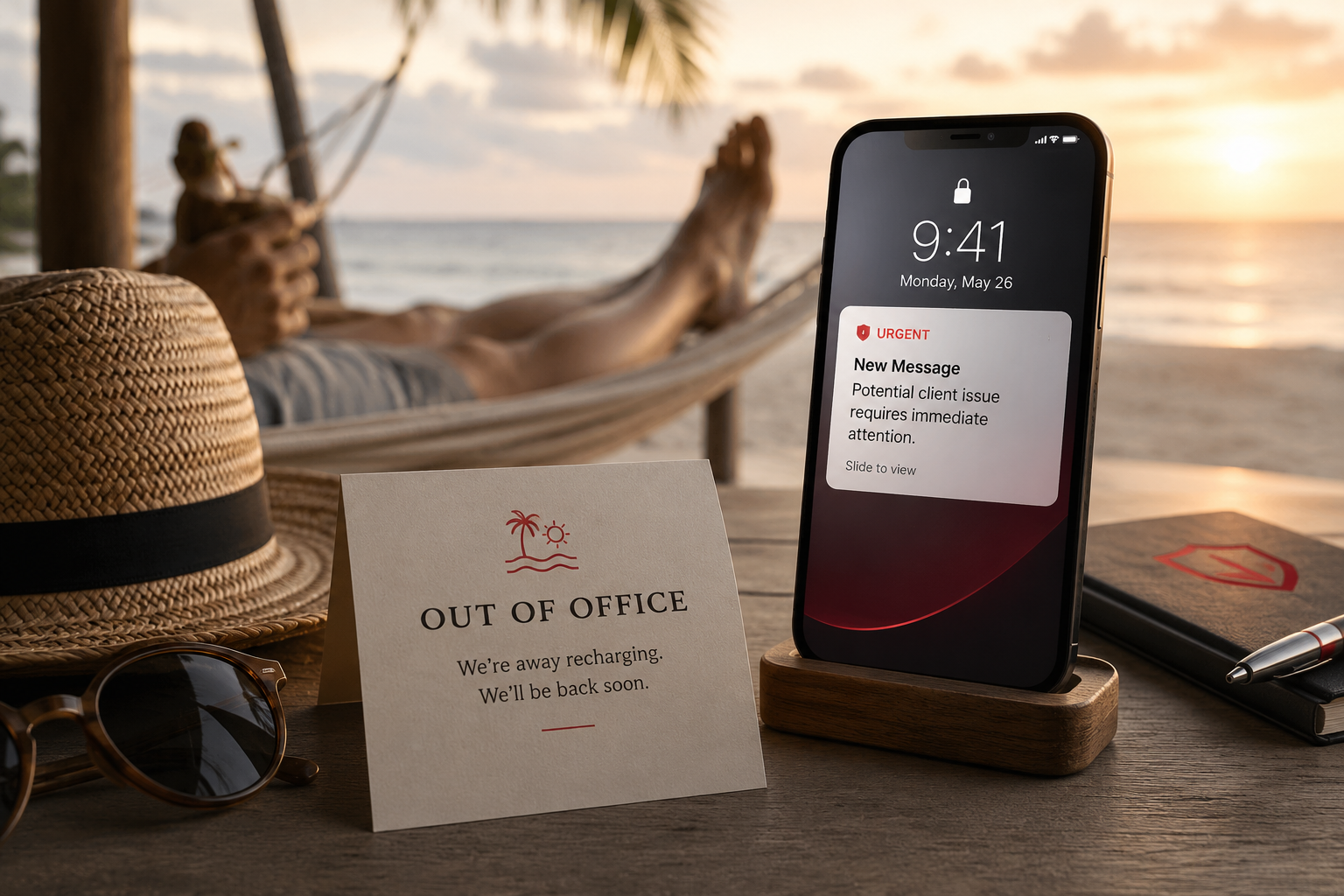
Summer and the holidays bring something every business owner looks forward to: a little time away. But here is something most owners never consider. The same conditions that make vacation season relaxing for you make it prime hunting season for scammers. When you are out of the office, when your team is short-staffed, when people are distracted and covering for each other, criminals see opportunity. And they plan around it.
This is not a reason to cancel your vacation. You have earned the break, and you should take it. It is a reason to understand why the risk rises when people are away, and to put a few simple protections in place so you can actually relax instead of worrying. Let me walk you through why scammers love this season and how to stay covered while you are out.
Why criminals target the times you're away
It comes down to a simple truth: scams work best when the people who would catch them are not paying full attention. Vacation season creates exactly those gaps, in a few predictable ways.
When key people are out, normal checks break down. The person who would normally notice a suspicious request might be on a beach. The approval that usually involves two people might get rushed through by the one person holding down the fort. Decisions that would normally be double-checked get made quickly, by someone who does not want to bother the boss on vacation.
That last point is the heart of the most common vacation scam. Criminals love to impersonate an owner or manager who is known to be away. The message arrives: "Hi, I'm traveling and tied up, but I need you to handle an urgent payment quickly, I'll explain when I'm back." It works because the boss really is away, the request feels plausible, and the employee wants to be helpful and not interrupt the vacation. The scammer is exploiting your absence and your team's good intentions at the same time.
Add in the small things, distracted employees, temporary staff covering unfamiliar tasks, the general summer slowdown in vigilance, and you get a season where the same scam that might fail in a fully staffed, focused office has a much better chance of succeeding.
The out-of-office reply that helps the scammer
Here is a specific one worth knowing, because almost everyone does it. The automatic out-of-office email reply, helpful as it is, can hand a scammer exactly what they need. A reply that says "I'm out until the 20th, for urgent matters contact Sarah at this number" tells a criminal that you are away, for how long, and who is covering, the perfect recipe for impersonating you to Sarah while you are unreachable.
You do not have to stop using out-of-office replies. Just keep them lean. Share less. "I'm currently out of the office and will respond when I return" is plenty for most senders. Avoid broadcasting your exact dates and detailed backup contacts to the whole world, since you cannot control who reads it.
How to stay protected while you're out
A little preparation before you leave lets you actually enjoy being away. Here is the practical checklist.
- Set a clear rule for money and sensitive requests, especially while you're away. The most important protection: agree that any payment, banking change, or sensitive request gets verified through a known, separate channel, no matter how urgent it sounds or who it appears to come from. Make sure your team knows that a rushed "I'm traveling, just handle this" message is exactly the kind to slow down and confirm, not to rush. This single rule defeats the most common vacation scam.
- Tell your team you would rather be interrupted than have them rush. Relieve the pressure that scammers exploit. Let your people know explicitly that it is always okay to pause and verify, even if it means a quick message to you on vacation. You would much rather get a "is this really you?" text than come back to a fraud. Giving that permission out loud removes the very hesitation criminals count on.
- Make sure protections are on before you go. Confirm multi-factor authentication is enabled on key accounts, so a scam or stolen password while you are away cannot easily turn into a breach. This is a good thing to verify before any trip.
- Keep out-of-office replies minimal. As above, share that you are out without broadcasting the details a scammer could use.
- Make sure someone is watching. If you have monitoring or a security partner, this is when it earns its keep, catching trouble while you and your team are at reduced attention. If you do not, at least make sure there is a clear point of contact for anything that looks off while you are gone.
How we think about it
Vacation season is a great illustration of why protection should not depend entirely on people being alert in the moment, because people are sometimes away or distracted, and that is exactly when trouble comes. This is the thinking behind how we work at Red Door Shield, through a simple framework we call KIT: Keep, Inspect, Trust. Keep what is valuable secure, so the protections hold whether or not you are at your desk. Inspect what is coming in, with monitoring that does not take a vacation, watching for trouble even when your team's attention is stretched. And trust through validation, the verify-before-you-act rule that protects you precisely when the usual checks are thin. The goal is simple: that your business stays protected even when the people in it are, rightly, taking a break.
What ready looks like
Picture actually relaxing on your time off, because you prepared. Your team knows the rule: any urgent money request gets verified, no exceptions, no matter how convincingly it seems to come from you. Your out-of-office reply gives away nothing useful. Your protections are on, and something is watching while attention is low. The scammer's favorite season finds your business buttoned up, and the "I'm traveling, handle this payment" message gets a calm phone call instead of a wire transfer.
That is what ready feels like, even from a beach chair. Not worrying about the office while you are away, but knowing it is covered so you can truly be away.
You should take your vacation, and you should enjoy it. Just take a few minutes before you go to close the gaps that scammers count on, especially the verify-before-you-pay rule and a lean out-of-office reply. And if you want the peace of mind of knowing someone is watching your business even when you and your team are out, that is a conversation worth having before your next trip.
Learn how to spot deepfake voice scams, read about text message scams, or see how payment fraud targets businesses.
Know Where Your Business Stands
Our free Business Security Assessment gives you a clear picture of your current security posture in less than 10 minutes. No technical knowledge required.
Not sure where your business actually stands?
Take our free Business Security Assessment. In under 10 minutes, you will know exactly where your gaps are and what it would take to close them.
Get My Free Security Assessment