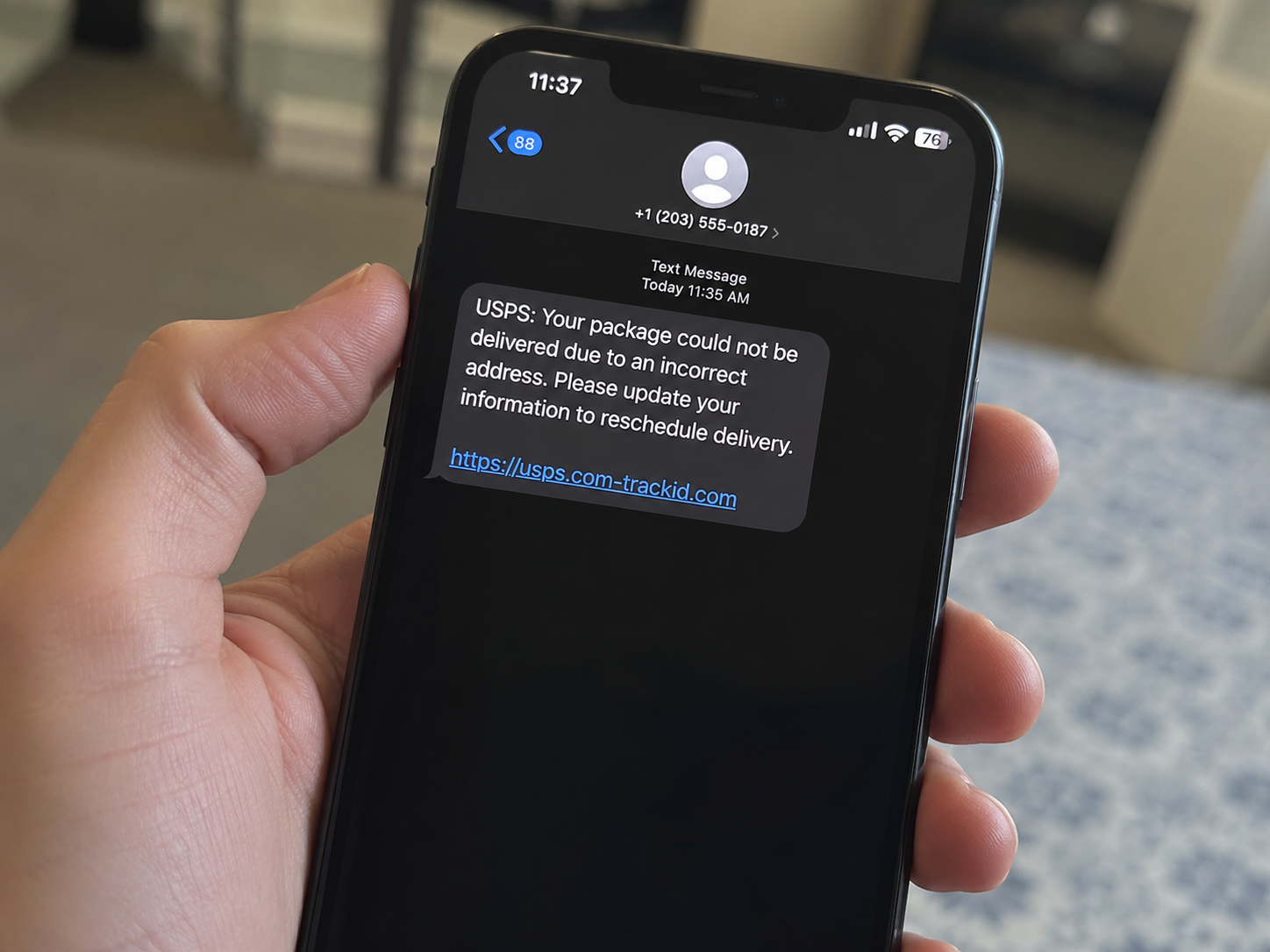
You have gotten the text. A package could not be delivered, tap here to reschedule. Your bank has detected unusual activity, confirm your account now. You have an unpaid toll, pay immediately to avoid a fine. They arrive out of nowhere, they create a little jolt of worry, and they are almost always fake. Scam text messages have quietly become one of the most common ways criminals try to reach all of us, and they are landing on the same phones you and your team use to run the business.
We have spent years teaching people to be suspicious of email. Criminals noticed, and they moved to texting, where people are far less guarded. A text feels personal and urgent in a way email does not, and most of us tap before we think. This piece is about flipping that instinct. There is a name for these attacks, a clear set of warning signs, and one simple rule that defeats nearly all of them. Let me walk you through it, because this is something you can get good at today.
What these scams are and why they work
The technical name is smishing, a mash-up of SMS, meaning text message, and phishing. It is the same idea as a phishing email, just delivered to your phone: a message designed to trick you into clicking a malicious link, handing over information, or sending money.
They work for a few specific reasons, and it helps to see them clearly. Texts feel more trustworthy than email, because we mostly use texting with people we know, so our guard is naturally down. Texts feel urgent, because we read them immediately and they are short and punchy. And on a small phone screen, the usual clues are harder to spot, because you cannot easily see where a link really goes or scrutinize the sender. The scammer is counting on all three: trust, urgency, and a small screen, to get you to tap before your slower, more skeptical brain catches up.
For a business, the risk is real. The same phone receiving a fake delivery text is the phone holding your email, your apps, and your logins. A tap on the wrong link, or a moment of entering a password into a fake page, can hand a criminal a foothold into your business, not just your personal life.
The warning signs to watch for
Once you know the patterns, scam texts become much easier to spot. Here are the signs that should make you pause.
- It creates urgency or fear. Almost every scam text pressures you to act right now: your account will be closed, a fine will be charged, a package will be returned. Urgency is the scammer's favorite tool, because hurried people do not think carefully. Real organizations rarely demand instant action by text.
- It comes from an unknown or odd number. Legitimate businesses often use recognizable short codes. Scam texts frequently come from regular-looking phone numbers, sometimes from other countries, or from email-address-style senders.
- It contains a link they want you to tap. The goal of most scam texts is to get you onto a fake website that looks real, where you will enter a password or payment details. Be especially wary of shortened or strange-looking links, and remember that on a phone you often cannot see the true destination.
- It asks for information or money. A text asking you to confirm a password, enter card details, verify personal information, or send a payment is a giant red flag. Legitimate organizations do not collect sensitive information through a texted link.
- It is unexpected. You were not expecting a package, you do not use that bank, you have no idea what toll they mean. A message about something that does not match your life is very likely a scam casting a wide net.
The one rule that defeats almost all of them
Here is the simple habit that protects you, and it is worth teaching to everyone on your team and at home: never act directly from a text. Do not tap the link. Do not call the number in the message. Do not reply with information.
Instead, if a text might be real, go to the source yourself, separately. If it claims to be your bank, open your bank's app or type their known website into your browser. If it is about a package, go to the carrier's official site and enter the tracking number yourself. If it claims to be from a coworker or vendor asking for something unusual, contact them through a number or channel you already know. The genuine version of any real message will be waiting for you when you go directly. The fake version only works if you use the path the scammer provided. Take away that path, and the scam falls apart.
And when a text is clearly junk, do not engage at all. Do not reply, not even "STOP," to an obvious scam, because it confirms your number is active. Most phones let you report and block the message as junk, which is the right move.
How we think about it
Scam texts are a perfect example of why protection has to be both human and technical, which is how we approach everything at Red Door Shield through a simple framework we call KIT: Keep, Inspect, Trust. Keep what is valuable secure, so that even if someone is tricked, protections like multi-factor authentication keep a single mistake from becoming a breach. Inspect what is coming in, through the monitoring and email security that filter out many threats before a human ever has to judge them. And trust through validation, which is exactly the rule above: you do not trust a message because it sounds urgent or familiar, you verify it through a channel you control. Technology catches a great deal, and a team that knows the warning signs catches the rest.
What ready looks like
Picture the next scam text landing on your phone, or a team member's, and instead of a worried tap, there is a calm, almost automatic response: pause, recognize the pattern, go to the source directly, and move on. The scam simply does not work, because everyone knows the rule. The constant trickle of fake texts becomes background noise you are immune to rather than a series of near misses.
That is what ready feels like. Not hoping no one on your team ever taps the wrong link, but knowing they have the instinct to stop and check.
These scams are everywhere now, and they are not going away, because they are cheap to send and they sometimes work. The defense is not fancy. It is awareness and one good habit, shared with your team. If you would like help building that awareness across your business, and the technical protections that back it up, that is a conversation worth having today.
Learn about the deepfake voice scam, read our guide to spotting a phishing email, or review the 8-point cybersecurity checklist.
Know Where Your Business Stands
Our free Business Security Assessment gives you a clear picture of your current security posture in less than 10 minutes. No technical knowledge required. No jargon. Just honest answers.
Not sure where your business actually stands?
Take our free Business Security Assessment. In under 10 minutes, you will know exactly where your gaps are and what it would take to close them.
Get My Free Security Assessment