Almost overnight, AI tools became part of how everyone works. Your team uses them to write emails, summarize documents, clean up proposals, and answer questions in seconds. It is genuinely useful, and I am not here to tell you to stop. But there is a quiet risk in how these tools are being used in nearly every small business right now, and most owners have no idea it is happening.
It is not a dramatic hack. It is something far more ordinary. Every day, people paste real business information into AI tools to get help with it: a client contract, a list of customer details, a financial summary, an employee's information, sometimes whole documents. It feels harmless because the tool just hands back a tidy answer. But that information left your business the moment it was pasted, and where it went is a question almost no one stops to ask. This is one of the fastest-growing ways sensitive data is quietly leaving small businesses, and the good news is that it is also one of the easiest to get right once you understand it.
What actually happens when you paste
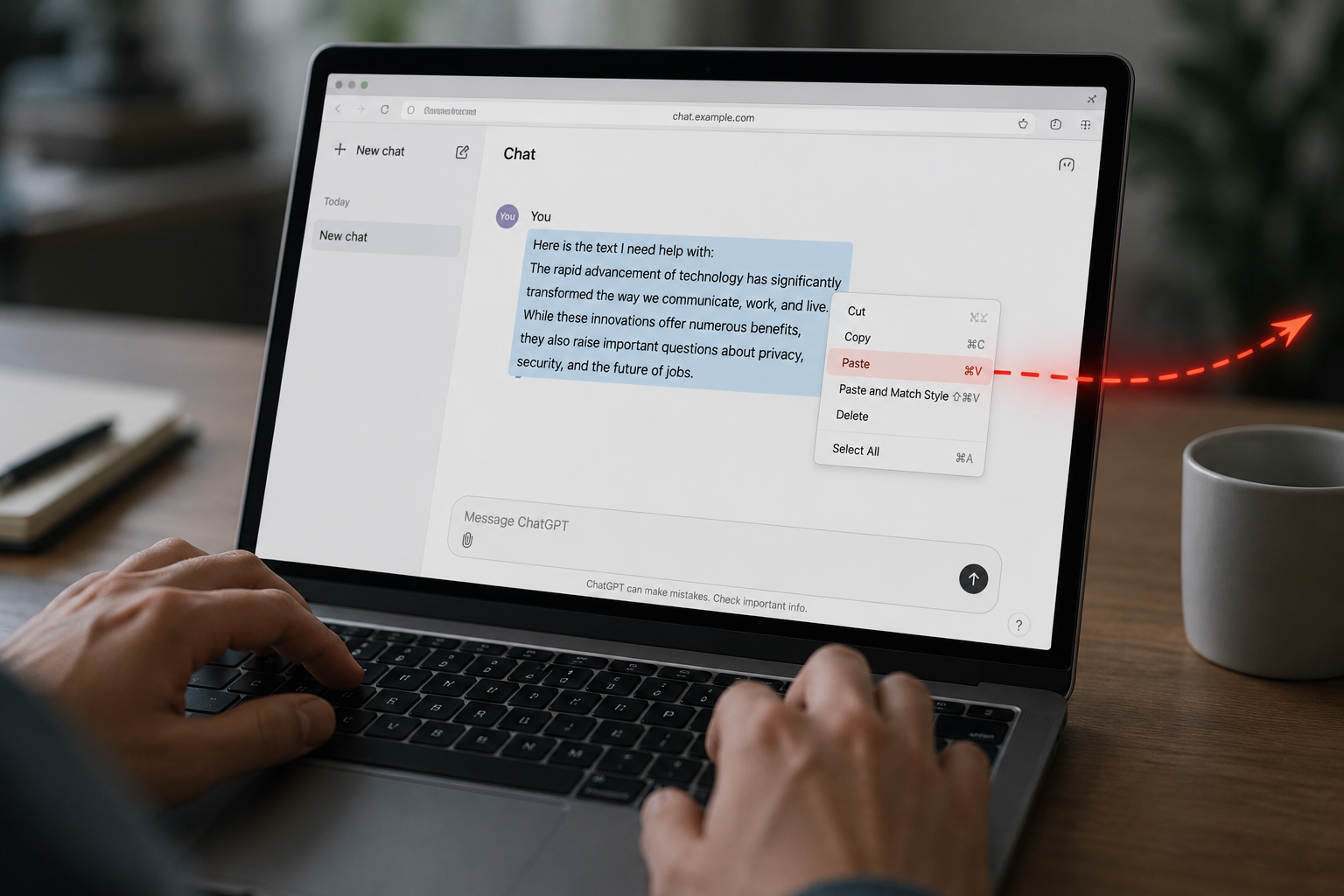
Here is the part that surprises people. When someone pastes information into a public AI tool, that text is sent off to a company's servers somewhere else. Depending on the tool and the account settings, it may be stored, it may be reviewed by people to improve the service, and in some cases it may be used to train future versions of the system. In plain terms, you have handed your information to an outside company, often without reading the fine print on what they are allowed to do with it.
This is not a fringe behavior. Studies in 2026 find that the large majority of employees paste data into AI tools, and that a striking share of those pastes contain sensitive corporate information. It has quietly become one of the leading ways business data leaves organizations. And most of it happens through personal accounts that the business has no visibility into at all. Your information is going out the door, and you cannot even see it happen.
The reason this flies under the radar is that it does not feel like a security event. There is no warning, no alarm, no obvious consequence. The tool is helpful, the answer comes back, and everyone moves on. The leak is invisible, which is exactly what makes it easy to do over and over.
Why this is a real problem, not a hypothetical
It helps to make it concrete. Picture a few ordinary moments that happen in businesses every single day.
Someone pastes a client's contract into an AI tool to get a plain-English summary. That contract, with its terms and the client's information, is now sitting on an outside company's servers. Someone drops a spreadsheet of customer contacts in to clean up the formatting. That customer list has left the building. Someone asks the AI to help write a sensitive email about an employee, pasting in the details. That employee's private information is now out of your control.
None of these people did anything malicious. They were being efficient. But each one quietly moved sensitive information, your clients' or your employees' or your own, outside your business and into a system whose rules you never reviewed. If you have promised clients their information stays protected, or if you are bound by rules about how you handle certain data, that promise just developed a gap you did not know existed. And if that outside system is ever breached, your information is in the pile.
This is the modern version of an old truth. The threat is not always someone breaking in. Sometimes it is information quietly walking out, carried by good people trying to do their jobs faster.
How to use AI safely (without banning it)
The answer is not to forbid AI tools. They are too useful, and a ban just pushes people to use them secretly on personal accounts, which is worse. The answer is a small amount of clarity and one simple rule everyone can follow.
The rule is this: never paste anything into a public AI tool that you would not be comfortable posting in public. If it contains a client's information, an employee's information, financial details, passwords, or anything confidential, it does not go in. If you need AI's help with sensitive material, remove or replace the identifying details first, or use a business-grade AI tool that contractually keeps your data private and out of training. Many providers offer business versions designed exactly for this, where your information is not used to train the system and is handled under real protections.
A few supporting moves make that rule stick. Talk with your team about it plainly, because most people have simply never been told and will happily do the right thing once they know. Decide together which tools are approved for work and which are not. And use business accounts rather than personal ones, so the business has appropriate settings and visibility instead of information flowing out through channels no one can see.
How we think about it
This is exactly the kind of modern, easy-to-miss risk we help businesses get ahead of at Red Door Shield, through a simple framework we call KIT: Keep, Inspect, Trust. Keep what is valuable secure, which now includes being deliberate about where your information is allowed to go, not just who is allowed in. Inspect what is coming in and going out, so data leaving through new channels like AI tools is part of the picture, not a blind spot. And trust through validation, which means setting clear, sensible rules for powerful new tools rather than hoping everyone guesses right. New technology brings new doors, and the job is to make sure the useful ones stay open while the risky ones stay controlled.
What ready looks like
Picture your team using AI tools confidently and productively, with a clear, shared understanding of what goes in and what does not. Picture knowing that your clients' information is not quietly accumulating on some outside company's servers because someone wanted a faster summary. Picture being able to answer honestly, if a client ever asks, that their data stays protected, because you actually thought about this before it became a problem.
That is what ready feels like. Not fearing new technology and not ignoring its risks, but using it with eyes open and simple guardrails in place.
AI is going to keep changing how you work, and that is a good thing. The businesses that handle it well will not be the ones that banned it or the ones that ignored the risk. They will be the ones that used it deliberately, with a clear rule and a little awareness. If you want help thinking through safe AI use and the other modern risks facing your business, that is a conversation worth having while these habits are still forming, not after something has already slipped out.
Review our 8-point cybersecurity checklist, learn why cybersecurity feels overwhelming, or read about other modern risks like voice cloning scams.
Know Where Your Business Stands
Our free Business Security Assessment gives you a clear picture of your current security posture in less than 10 minutes. No technical knowledge required. No jargon. Just honest answers.
Not sure where your business actually stands?
Take our free Business Security Assessment. In under 10 minutes, you will know exactly where your gaps are and what it would take to close them.
Get My Free Security Assessment