You have seen it everywhere. A little "SOC 2" badge on a software company's website, a line in a vendor's sales pitch, a reassuring mention in a proposal: "We are SOC 2 compliant." And if you are like most business owners, you nod along as if you know exactly what that means, while quietly not being entirely sure. It sounds official and secure, so you take it as a good sign and move on. That instinct is not wrong, but it is worth actually understanding, because SOC 2 tells you something genuinely useful, and it also does not prove some things people assume it does.
So let me demystify it in plain English. What SOC 2 actually is, what it audits, the difference between the two types you will hear about, and, importantly, what a SOC 2 badge does not guarantee. By the end, you will be able to look at that badge and read it intelligently, which matters both when you are vetting vendors who will hold your data and when you are thinking about what verified security really means. Let us dig in.
What SOC 2 actually is
SOC 2 is, in plain terms, an independent examination of how well a company protects the data and systems it handles. It was developed by the accounting profession as a standardized way for service companies, especially those that store or process other people's data, like software and technology vendors, to demonstrate that an outside, independent auditor has examined their security practices.
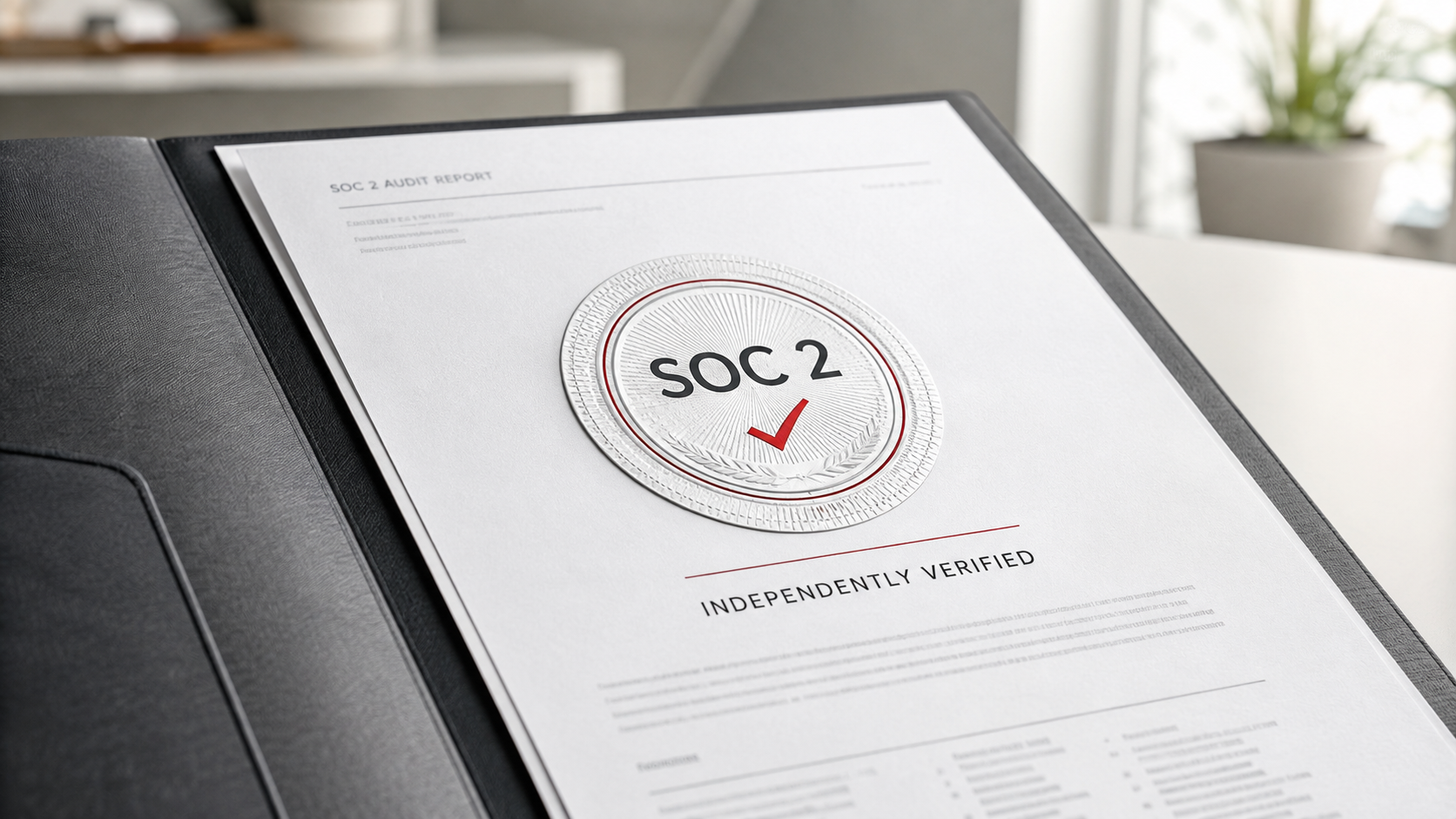
Here is a useful clarification most people miss: SOC 2 is technically an audit report, not a pass-fail certificate. When a company says it is "SOC 2 compliant," what really exists is a detailed report, produced by an independent auditor, describing the company's security controls and whether they meet a defined set of criteria. So it is more accurate to think of SOC 2 as "an independent auditor examined our security and wrote a report on it" than as "we passed a government test." That distinction matters, because it shapes what the badge does and does not tell you.
The value is real: a company that has gone through a SOC 2 examination has invited an outside expert to scrutinize its security and has a formal report to show for it, which is a meaningful signal of seriousness. It is independent verification rather than a company simply claiming, on its own say-so, that it is secure.
What SOC 2 audits
SOC 2 examines a company's controls against a set of principles known as the Trust Services Criteria. The central one, always included, is Security, essentially, whether the company protects its systems and data against unauthorized access and other risks. Beyond security, a SOC 2 examination can also cover, depending on what the company chooses to include, availability (whether systems are reliably up and running), processing integrity (whether systems work correctly), confidentiality (whether sensitive information is kept confidential), and privacy (how personal information is handled).
In practice, the auditor looks at the company's actual controls, things like how they manage access, protect data, monitor their systems, and respond to problems, and assesses whether those controls meet the criteria. The result is that report, documenting what was examined and what the auditor found. Notice that the company has some say in what is included and in scope, which is one reason the details matter more than the badge.
Type I versus Type II: the difference that matters
You will hear SOC 2 described as "Type I" or "Type II," and the difference is genuinely important, so it is worth understanding.
A SOC 2 Type I report evaluates whether a company's security controls are suitably designed at a single point in time. It is essentially a snapshot: as of this date, the company has the right controls in place, on paper and in design. That is useful, but it only says the controls existed and were properly designed at that moment.
A SOC 2 Type II report goes further and is more meaningful. It evaluates whether those controls actually operated effectively over a period of time, typically several months to a year. Rather than a snapshot, it is more like a video: the auditor confirms that the controls were not just in place but genuinely working, consistently, over an extended stretch. Because it demonstrates that security is not just designed but reliably practiced over time, a Type II report is the stronger, more reassuring one, and it is what serious vendors typically pursue.
So when a vendor mentions SOC 2, a reasonable and revealing question is simply: "Type I or Type II?" A Type II tells you considerably more than a Type I.
What SOC 2 does NOT prove
Here is the part that keeps you from over-reading the badge, and it is where informed owners separate themselves from those who just nod along. SOC 2 is a positive signal, but it is not a guarantee of a few things people often assume.
It does not guarantee a company will never be breached. SOC 2 shows an auditor found the company's controls met the criteria; it does not make them invulnerable, and companies with SOC 2 reports have still had incidents. It is not a promise of perfect security, and no honest examination could be.
It only covers what was in scope. The report examines specific systems and controls the company defined, so a SOC 2 report might cover one product or part of a business and not others. "The company has SOC 2" does not automatically mean the particular service you are using is covered; the scope in the actual report is what tells you.
It reflects a point or period in time, not necessarily this moment. Security can change after an audit period ends, so a report is a look at a past window, which is part of why the recency and type of the report matter.
And a badge is not the report. Displaying a SOC 2 logo is not the same as the detailed report itself. A vendor who takes it seriously can usually share the actual report (often under an agreement), and the report, its scope, its type, its findings, is where the real information lives, not the badge alone.
None of this means SOC 2 is not worth anything, quite the opposite. It means SOC 2 is a valuable data point to read intelligently, not a magic guarantee to accept blindly.
Why this matters for you
Understanding SOC 2 helps you in two concrete ways. First, when you are choosing vendors who will hold your business's or your customers' data, a SOC 2 report, especially a current Type II with relevant scope, is a genuine mark in a vendor's favor, evidence they have had their security independently examined rather than just claiming it is fine. This is exactly the kind of vetting we encourage in managing third-party risk: you are trusting a vendor's security as if it were your own, so independent verification helps you trust wisely. Being able to ask "Type I or Type II, and what is in scope?" makes you a far more informed buyer.
Second, it sharpens what you should value in security generally: independent verification over unverified claims. The whole point of SOC 2 is that an outside expert checked, rather than the company simply asserting it is secure. That principle, provable, verified protection rather than "trust us," is the right standard to hold, both in the vendors you choose and in your own security.
How we think about it
That standard of verified, provable protection is exactly what we believe in at Red Door Shield, and it shapes how we think about security through a simple framework we call KIT: Keep, Inspect, Trust. Keep what is valuable secure, with real, independently validated protections rather than unverified promises. Inspect and validate, because security that is genuinely examined and demonstrated is worth far more than security merely claimed. And trust through validation, which is the very spirit of SOC 2 and of our whole approach: do not just take a vendor's word, or ours, verify it. Our platform is built on independently verified, enterprise-grade standards precisely because we believe protection should be provable, not a matter of guesswork. When we say your business is protected, it is backed by verified security, the same principle that gives a SOC 2 report its value.
What ready looks like
Picture yourself reading a vendor's SOC 2 badge with clear eyes: understanding that it means an independent auditor examined their security, knowing to ask whether it is the stronger Type II and what is in scope, and treating it as a valuable signal rather than a blanket guarantee. You choose the vendors who hold your data more wisely, and you hold your own security to the same standard of provable protection. The badge that once made you nod along now tells you something specific and useful.
That is what ready feels like when it comes to SOC 2 and security claims in general. Not taking a badge at face value or dismissing it, but reading it intelligently and valuing verification over assertion.
SOC 2 is worth understanding because it appears everywhere and it genuinely means something, an independent examination of a company's security, with Type II being the more meaningful version, and with real limits on what it proves. Read it as the useful signal it is, ask the right questions, and value verified protection over unverified claims, in your vendors and in your own business. If you want protection that is real and provable rather than a matter of guesswork, our free Business Security Assessment is the place to start, and it is a conversation worth having today.
Not sure where your business actually stands?
Take our free Business Security Assessment. In under 10 minutes, you will know exactly where your gaps are and what it would take to close them.
Get My Free Security Assessment