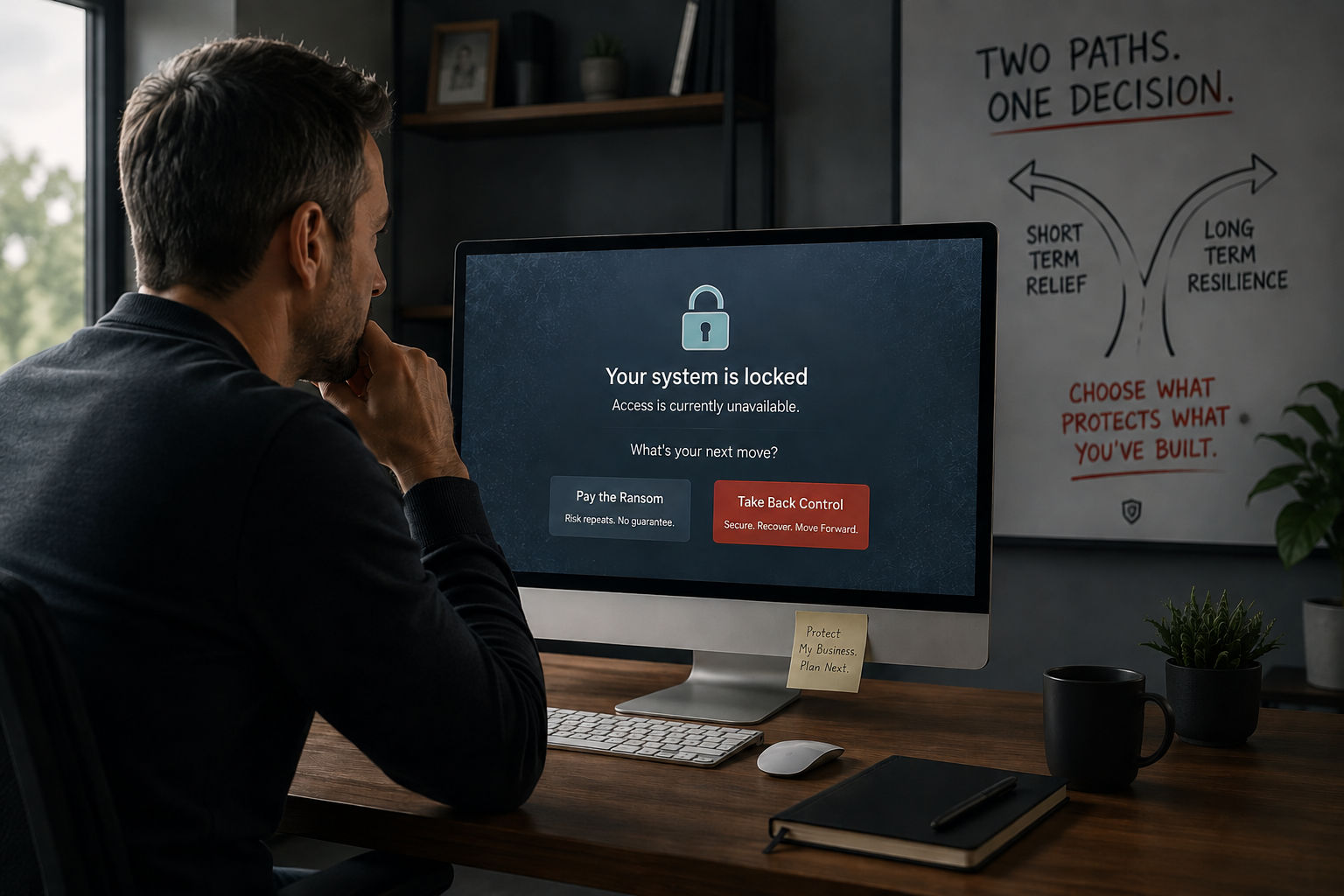
Imagine walking into your business one morning and finding every file locked. Your systems frozen. A message on the screen demanding payment, often in cryptocurrency, to get your data back. The clock is ticking, the pressure is enormous, and you are facing a question you never thought you would have to answer: do you pay?
It is one of the most agonizing decisions a business owner can face, and the worst possible time to think it through for the first time is in the middle of the crisis, when panic and pressure are highest. So let us think it through now, calmly, in advance. This article is not legal or financial advice, and if you are ever actually in this situation you should involve professionals and, where appropriate, law enforcement. But understanding the realities beforehand will help you make a clearer decision if it ever comes to that, and, more importantly, it will show you why the real decision happens long before an attack ever occurs.
Why this is not a simple question
The instinct, when your business is on the line, is to just pay and make the nightmare end. That instinct is completely understandable. But paying a ransom is far from a guaranteed fix, and it carries real problems that are worth understanding before you are staring at that screen.
Start with the most basic issue: paying does not guarantee you get your data back. You are dealing with criminals. Some provide a working decryption key after payment; others take the money and disappear, or provide a key that only partially works, or come back to demand more. When you pay, you are trusting the word of the very people who attacked you. A meaningful share of businesses that pay do not fully recover their data anyway.
Then there is the uncomfortable bigger picture. Paying ransoms funds and encourages the criminal enterprise. Every payment makes ransomware more profitable, which funds the next wave of attacks against other businesses, and marks you as a business that pays, which can make you a target again. Law enforcement agencies generally discourage paying for exactly these reasons.
There are also legal and regulatory wrinkles. Depending on who the attackers are and where they operate, making a payment can carry legal complications, which is one of many reasons to involve professionals rather than quietly paying on your own. And modern ransomware often adds a second threat: even if you could restore your data from backups, the attackers may have stolen a copy and threaten to leak it unless you pay, which is its own separate and thorny problem.
None of this means the decision is always obvious. For a business with no other way to recover critical data, the pressure to pay is immense and very human. The point is that paying is not a clean solution, and it should never be the first or only plan.
What actually determines your options
Here is the insight that changes everything, and it is the real reason to think about this now rather than later. When a ransom demand appears, your options are almost entirely determined by decisions you made before the attack. The crisis does not create your choices. It reveals them.
Consider two businesses hit by the exact same ransomware. The first has reliable, tested, protected backups. For them, the ransom demand is serious but not catastrophic. They can decline to pay, restore their systems from clean backups, and recover, treating the attack as a hard disruption rather than an existential threat. They have leverage, because the criminals no longer hold the only copy of what matters.
The second business has no usable backups, or backups that were never tested, or backups the ransomware also managed to lock. For them, the same demand is a nightmare with no good exit. Pay and hope, or lose everything. They have no leverage, because the attacker holds the only path back to their data.
Same attack, completely different situations, and the difference was decided long before the attack, by whether they had prepared. This is why the honest answer to "should I pay the ransom?" is really another question: what did you do beforehand to make sure you would not have to? Your backups, your protections, and your plan are what determine whether a ransom demand is a manageable event or a business-ending one.
The decision, if you are ever in it
If the worst does happen, here is the calm framework, and the first rule is to not decide alone or in a panic. Bring in a professional incident response service, contact your cyber insurance carrier if you have one, since many provide expert guidance and may have requirements, and involve law enforcement, who can advise and who track these attacks. This is not a decision to make quietly and quickly by yourself.
With that help, the questions become clearer. Can you recover from backups instead of paying? If yes, that is almost always the better path. What exactly is at stake, and is it truly unrecoverable any other way? What are the legal and practical risks of paying in your specific situation? And throughout, remember that paying is a last resort with no guarantees, not a reliable fix. The goal is a clear-eyed decision made with expert help, not a panicked payment made in isolation.
But notice how much better every one of these questions goes for the business that prepared. Preparation does not just reduce the chance of an attack. It transforms the decision if one ever happens.
The real answer: make the question irrelevant
So here is the most useful way to think about "should you pay the ransom?" The best answer is to arrange your business so that you never have to seriously consider it. That is entirely achievable, and it comes down to the things we write about often.
Strong prevention makes an attack far less likely in the first place: multi-factor authentication, protected and updated devices, email security, careful habits, and monitoring that catches an intruder early. And reliable, tested, protected backups make an attack survivable if one gets through, because you can restore rather than pay. Add a simple response plan so a crisis is handled calmly, and you have turned the terrifying ransom question into a manageable recovery. The businesses that never have to agonize over paying are simply the ones that prepared so they would not have to.
That is the quiet power of getting ahead of this. You are not just lowering your odds of being attacked. You are making sure that if you are, you hold the leverage, not the criminal.
How we think about it
Making the ransom question irrelevant is exactly what we aim for at Red Door Shield, through a simple framework we call KIT: Keep, Inspect, Trust. Keep what is valuable secure, including the tested, protected backups that give you a way back without paying, and the strong protections that make an attack less likely at all. Inspect what is coming in, with the monitoring that catches ransomware early, before it can spread and lock everything, when it is still stoppable. And trust through validation, with the planning and preparation that mean a crisis is met with steps rather than panic. We build businesses toward the position of the first company in our example, the one for whom a ransom demand is a bad day, not the end.
What ready looks like
Picture the nightmare scenario arriving, the locked screen, the demand, and instead of despair, you have options. You call your response team and your insurer, you decline to reward the criminals, and you restore from the clean backups you tested months ago. It is a hard day, and there is work to do, but your business survives, your data comes back, and you never had to trust a criminal or fund the next attack. The question that ends some businesses is, for you, a question you already answered by preparing.
That is what ready feels like. Not hoping you would make the right call under pressure, but having arranged things so the pressure never has that power over you.
Whether to pay a ransom is a decision no owner wants to face, and the surest way to win it is to make it a decision you never have to make. That is decided now, on a calm day, through prevention, tested backups, and a plan, not in the panic of a crisis. If you want to know whether your business could recover from ransomware without paying, especially whether your backups would actually save you, that is a conversation worth having today.
Learn about ransomware basics, read about business continuity planning, or see our guide on what to do in the first hour after an attack.
Know Where Your Business Stands
Our free Business Security Assessment gives you a clear picture of your current security posture in less than 10 minutes. No technical knowledge required.
Not sure where your business actually stands?
Take our free Business Security Assessment. In under 10 minutes, you will know exactly where your gaps are and what it would take to close them.
Get My Free Security Assessment