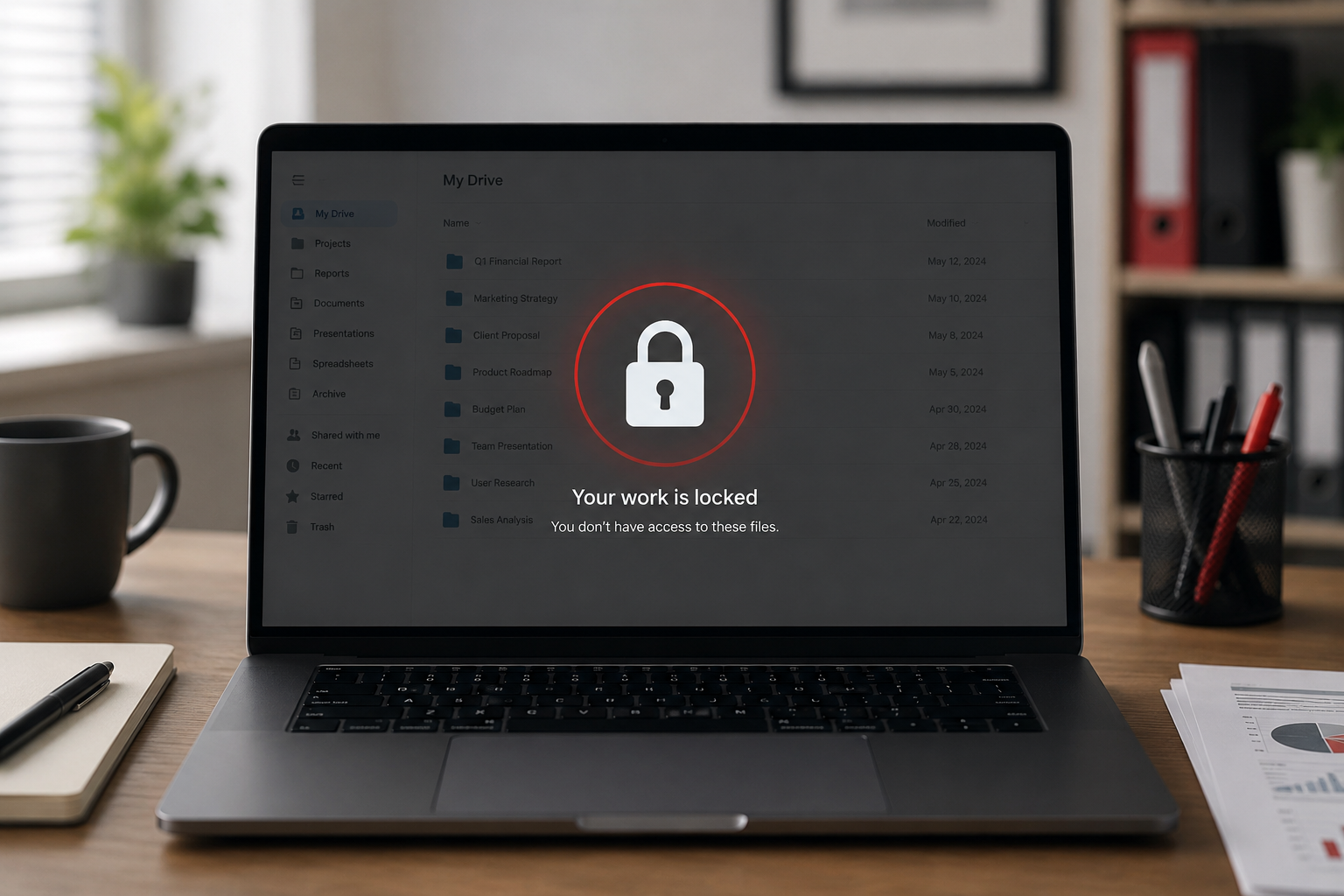
Ransomware is the threat that turns a normal Tuesday into the worst day of a business owner's year. You sit down, go to open your files, and instead of your work you see a message: your data has been locked, and if you want it back, you have to pay. Everything stops. The schedule, the invoices, the customer records, all of it, frozen behind a demand for money.
It sounds like something that happens to big corporations on the news. It is not. Ransomware hits small businesses constantly, and for a small operation the consequences are often far worse, because there is less cushion to absorb the blow. The good news is that ransomware is also one of the most preventable serious threats out there, once you understand how it works. So let me explain it plainly, with no jargon, and then show you exactly how to protect your business.
What ransomware actually is
Ransomware is a type of malicious software, malware, that does one specific, brutal thing: it locks up your files and systems so you cannot use them, then demands a payment, the ransom, in exchange for unlocking them. Think of it as a criminal sneaking into your building, putting your most important records in a safe, and walking off with the only key, then sliding a note under the door telling you what it will cost to get the key back.
The payment is usually demanded in cryptocurrency, because it is hard to trace. The amounts range widely, from a few thousand dollars aimed at small businesses to enormous sums aimed at large ones. And here is the cruel part that owners do not always realize until it is too late: paying does not guarantee you get your data back. You are trusting a criminal to keep their word. Many businesses pay and recover nothing, or recover only part of what was taken.
Modern ransomware has often gotten even nastier. Many attackers now steal a copy of your data before they lock it, then threaten to publish or sell it unless you pay. So even a business with good backups can face a second threat: pay up, or we leak your customers' information. This is why prevention matters so much more than any plan to simply restore and move on.
How it actually gets in
Ransomware does not usually break down the door. It gets invited in, almost always through one of a few predictable paths. Knowing them is most of the battle.
The most common entrance is email. Someone on your team receives a message with a malicious attachment or link, opens it believing it is legitimate, and that single click lets the ransomware in. The email is often disguised as an invoice, a delivery notice, or a message from a familiar contact.
The second common path is stolen or weak passwords. If an attacker can log into your systems, often using a password that leaked elsewhere or was easy to guess, they can plant ransomware directly. This is especially true for remote access tools that let people connect to work computers from outside the office.
The third is unpatched software. When software makers release updates, they are often fixing security holes. Systems that are not kept updated leave those holes open, and ransomware is built to crawl through them.
Notice the pattern. Email, passwords, and updates. The same handful of basics that protect against almost everything else are exactly what stop ransomware too. That is very good news, because it means you are not defending against something mysterious. You are closing a few well-known doors.
How to protect your business
Here is the practical part. These steps, taken together, stop the large majority of ransomware before it can ever take hold, and limit the damage if something does slip through.
- Protect your email. Since email is the number one entrance, strong email security that filters out malicious messages before they reach your team is your first and best defense. The best attack is the one your people never have to judge.
- Use multi-factor authentication and strong, unique passwords. Multi-factor authentication, the extra code sent to your phone, means a stolen password alone cannot let an attacker in to plant ransomware. Combined with unique passwords, this closes the second major door.
- Keep your systems updated. Turn on automatic updates where you can, so the security holes ransomware exploits get patched before anyone can use them. It is one of the simplest and most overlooked protections.
- Protect your devices with modern endpoint protection. This is your digital guard dog, watching for the suspicious behavior ransomware shows and stopping it before it can spread across your business.
- Keep reliable, tested backups. This is the protection that defangs ransomware. If your data is safely backed up and you have actually tested that you can restore it, then a ransomware demand loses most of its power, because you can rebuild rather than pay. The key word is tested. A backup you have never tried to restore is a guess, not a safety net. Keep backups protected and separate, so the ransomware cannot lock them too.
- Train your team. Because so many attacks start with a click, a team that knows what a suspicious email looks like is a genuine layer of defense. Not a one-time meeting, but ongoing awareness.
What to do if it happens
If you are ever facing a ransomware demand, do not panic and do not pay on impulse. Disconnect the affected device from the network to stop the spread, but leave it on. Call your security provider or a professional incident response service, and your cyber insurance carrier if you have one, because they can guide you and sometimes provide a response team. Do not negotiate or pay without expert guidance, because paying is risky and may not work. If your backups are good, this is the moment they save you.
How we think about it
Ransomware is exactly the kind of threat we built Red Door Shield to stop, through a simple framework we call KIT: Keep, Inspect, Trust. Keep what is valuable secure, which includes the protected, tested backups that make ransomware survivable and the strong logins that keep attackers out. Inspect what is coming in, which means the email security and monitoring that catch a threat before it spreads, and that flag trouble early instead of after your files are locked. And trust through validation, which keeps a convincing email from becoming the click that lets it in. Prevention, early detection, and the ability to recover, working together, are what turn ransomware from a business-ending event into something you are prepared for.
What ready looks like
Picture the worst version of that Tuesday, the locked screen, the demand for money, and instead of your business grinding to a halt, you have a path. The attack was likely stopped before it spread, because someone was watching. And even in the worst case, your data is safe in tested backups, so you can restore and get back to work rather than negotiating with a criminal. The threat is real, but it is not the end of anything, because you prepared for it.
That is what ready feels like. Not hoping you never see that screen, but knowing that if you do, it cannot take your business from you.
Ransomware is frightening precisely because it is so preventable, and so devastating to those who were not ready. You do not have to be one of them. The same handful of basics that protect against almost everything close the doors ransomware uses. If you want to know whether your business is genuinely protected, especially whether your backups would actually save you, that is a conversation worth having before the bad Tuesday, not after.
Review our 8-point cybersecurity checklist, learn what to do in the first hour after an attack, or read about what cyber insurers now require.
Know Where Your Business Stands
Our free Business Security Assessment gives you a clear picture of your current security posture in less than 10 minutes. No technical knowledge required. No jargon. Just honest answers.
Not sure where your business actually stands?
Take our free Business Security Assessment. In under 10 minutes, you will know exactly where your gaps are and what it would take to close them.
Get My Free Security Assessment