For most businesses, a cyberattack means stolen data. For a manufacturer or a machine shop, it means something more immediate and more painful: stopped production. When a criminal locks up your systems, the real damage is not just the data held hostage, it is the machines that go quiet, the workers standing idle, the orders that slip, and the customers waiting on parts you suddenly cannot ship. For a shop that runs on tight schedules and firm delivery dates, downtime is the real ransom, and it starts bleeding money within hours.
Chicagoland is full of small manufacturers and machine shops, the kind of solid, hardworking businesses that quietly keep the region's economy running. And they face a version of cyber risk that is genuinely different from an office-based business, shaped by the economics of downtime, the aging computers on the shop floor, and the security demands increasingly flowing down from their biggest customers. Let me walk through why manufacturers are so exposed and what actually protects a shop, in plain terms.
Why downtime is the real threat
Start with the economics, because they are what make manufacturing cyber risk so acute. Your business makes money when production is running. When it stops, the costs pile up fast and from every direction: idle labor you are still paying, machines producing nothing, deadlines you will miss, penalties or lost orders, and customers whose trust erodes with every day of delay. A few days of halted production can do more damage to a manufacturer than the attack itself, and for a shop operating on schedule commitments, even hours matter.
This is exactly why ransomware, which we explain in what is ransomware, is so dangerous for manufacturers specifically. Ransomware locks up your systems and demands payment, and for most businesses the pressure to pay is bad enough. For a manufacturer watching production sit frozen while orders back up and customers call, the pressure is enormous, because every hour of downtime is money lost and reputation damaged. Criminals know this. They understand that a manufacturer facing stopped production is highly motivated to pay quickly to get running again, which makes shops an attractive target. The threat is not really "we might lose some data." It is "we might not be able to make anything for days," and that is an existential problem for a production business.
The lesson: for a manufacturer, cybersecurity is really about keeping production running, and the ability to recover fast is everything.
The aging machines on the shop floor
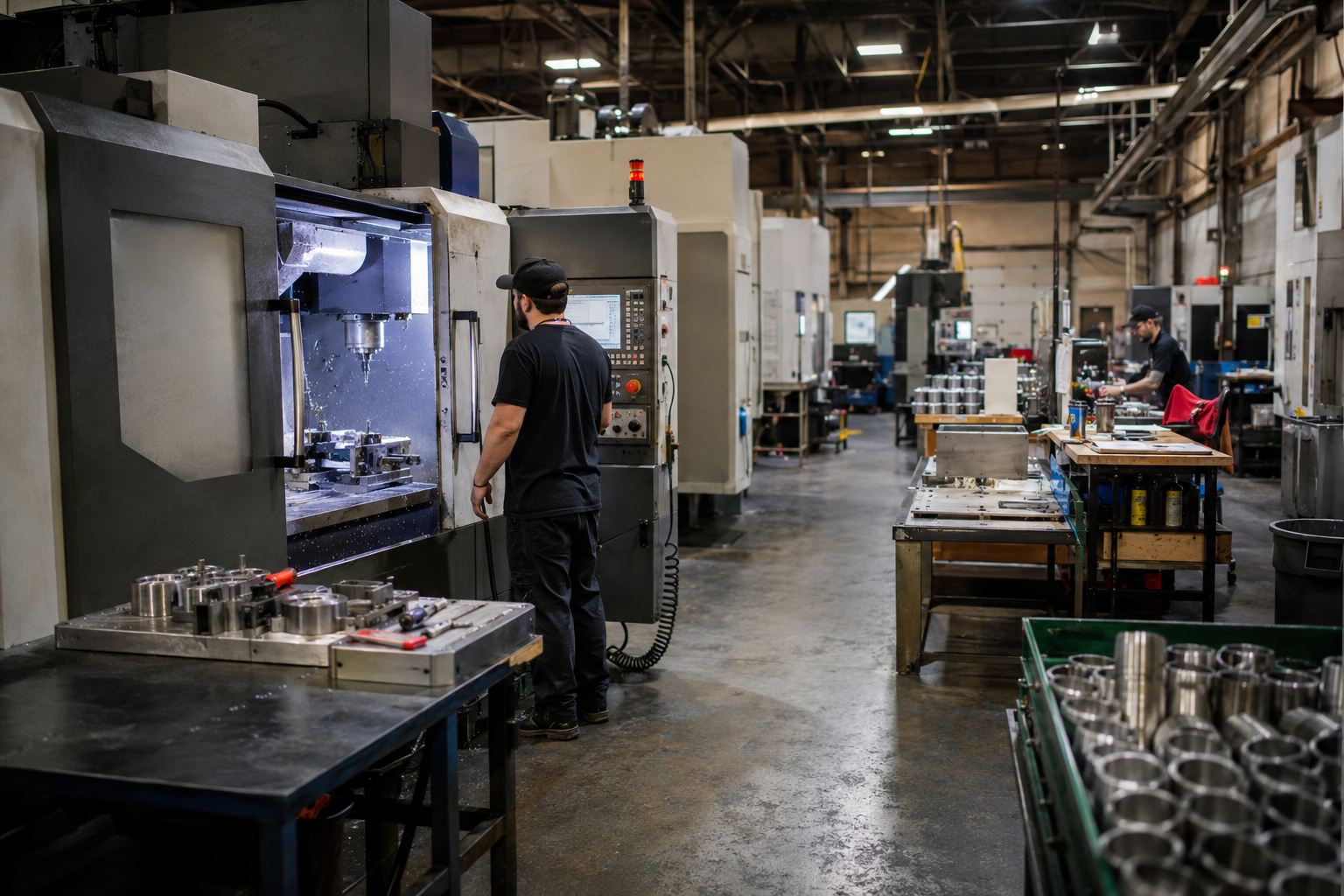
Here is a risk almost unique to manufacturing, and one that catches many shops off guard. Your shop floor is likely full of older computers, the ones running or connected to your CNC machines, your equipment, your production systems. And very often, those computers are running old, outdated, sometimes long-unsupported software, because the machine vendor's software requires it, or because the attitude, understandably, has been "if it works, do not touch it."
The problem is that those aging, unpatched machines are exactly what attackers look for, because outdated software has known security holes that will never be fixed. A shop-floor computer running an operating system that stopped receiving security updates years ago is a standing invitation, and it is often connected to the same network as everything else, which means it can become the doorway an attacker uses to reach your whole operation, including the systems that, if locked, stop production.
This is a genuinely tricky situation, because you often cannot simply update or replace these machines, since the equipment they run depends on that old software. But it is not hopeless. The key is to isolate and protect them. Rather than leaving vulnerable production computers exposed on your main network and reachable from the internet, you separate them, limit what can connect to them, and wall them off so that even though they are old and cannot be patched, they are not an open door. Where machines can eventually be upgraded, you plan for it, but in the meantime, containment is the practical protection. This kind of network separation is one of the most important and manufacturing-specific steps a shop can take.
When you share a network, you share the risk
Related to the aging-machine problem is a broader one: in many shops, the office systems and the shop-floor production systems sit on the same flat network, everything connected to everything. That means a problem anywhere, a phishing email opened in the front office, a compromised computer, can potentially spread to the production systems, and vice versa. A single weak point becomes a path to the machines that keep you running.
The fix is separation. Keeping your production network distinct from your office network, and both properly protected, means that trouble in one place is contained rather than free to spread to the systems whose downtime would hurt most. For a manufacturer, protecting the production side from whatever happens on the office side, and from the internet, is a foundational move.
The requirements flowing down from your customers
Now the commercial reality that is increasingly forcing the issue, and it is one small manufacturers cannot ignore. Larger manufacturers and the big customers, the OEMs, that your shop supplies are increasingly requiring their suppliers to meet cybersecurity standards as a condition of doing business. They understand that their own security depends on their supply chain, so they push requirements down to the smaller shops they buy from. For manufacturers serving certain industries, defense being a prominent example, formal security requirements can be mandatory to win or keep contracts.
What this means for a small manufacturer is that cybersecurity is no longer just about avoiding an attack. It is becoming a requirement to keep your customers and win new work. A shop that can demonstrate solid, documented security is positioned to keep and grow its contracts, while one that cannot may quietly lose business to competitors who can. This is the same dynamic we cover in passing a client security questionnaire: your security is becoming a factor in whether you get the business. For manufacturers, getting ahead of these requirements is both protection and a competitive advantage.
What actually protects a shop
Pulling it together, here is what protecting a manufacturer looks like in practice. Get the fundamentals in place, because they stop the attacks that lead to downtime: multi-factor authentication, email security, modern endpoint protection, keeping what can be updated updated, strong access controls, and team awareness. Because downtime is the real threat, put special weight on reliable, tested backups and a recovery plan built around getting production back fast, which is where a business continuity plan focused on your essential production systems is invaluable. Isolate and protect the aging shop-floor machines you cannot easily update, so they are contained rather than exposed. Separate your production and office networks so trouble cannot spread between them. And document your security, both to satisfy the requirements flowing down from your customers and because that documentation is what turns "we're secure" into provable diligence.
None of this requires you to become a cybersecurity expert. It requires the right protections, arranged for the specific realities of a shop, ideally with help from someone who understands both security and how a production business actually runs.
How we think about it
Protecting a manufacturer means protecting its ability to produce, which shapes how we approach it at Red Door Shield, through a simple framework we call KIT: Keep, Inspect, Trust. Keep what is valuable secure, including the production systems and the tested backups that let you recover fast, plus the isolated, contained protection for those aging shop-floor machines. Inspect what is coming in, with monitoring that catches threats before they spread to the systems whose downtime would stop your shop. And trust through validation, the documented, verifiable security that both protects your operation and satisfies the customers requiring it. We help manufacturers protect the thing that matters most, keeping production running, and prove that protection to the customers who now demand it.
What ready looks like
Picture a machine shop protected for its real risks: the fundamentals stopping most attacks, tested backups and a recovery plan ready to get production running again quickly if the worst happens, the old shop-floor computers isolated so they cannot be a doorway, the production and office networks kept separate, and your security documented and ready to show the OEMs who ask. If ransomware ever strikes, it does not mean days of frozen production and an agonizing choice about paying, it means a controlled recovery. And when a big customer asks about your security, you have a confident, documented answer that helps you keep the contract.
That is what ready looks like for a manufacturer. Not hoping an attack never stops your line, but being built so that production keeps running, or recovers fast, and your security helps you win business rather than lose it.
For a manufacturer or machine shop, downtime is the real ransom, and protecting your business means protecting your ability to produce, contain your vulnerable machines, and prove your security to the customers who now require it. The steps are practical and worth every bit of the effort, because your production, your reputation, and your contracts depend on them. If you want help protecting your shop for the way it actually runs, our free Business Security Assessment is the place to start, and it is a conversation worth having today.
Not sure where your business actually stands?
Take our free Business Security Assessment. In under 10 minutes, you will know exactly where your gaps are and what it would take to close them.
Get My Free Security Assessment