In nearly two decades of working with business owners, I have noticed something. The thing that leaves a business exposed is usually not a lack of effort or intelligence. It is a handful of beliefs that feel completely reasonable and happen to be wrong. These beliefs are comfortable, they are widely shared, and they quietly talk owners out of protecting themselves. I wrote about several of them in my book as "the lies," because that is what they are: comforting stories that leave you vulnerable.
So let me lay out the five most common ones plainly, give you the truth behind each, and tell you what to do instead. There is no judgment here. I believed some of these myself once. The point is simply that once you see through them, protecting your business stops feeling optional and starts feeling obvious.
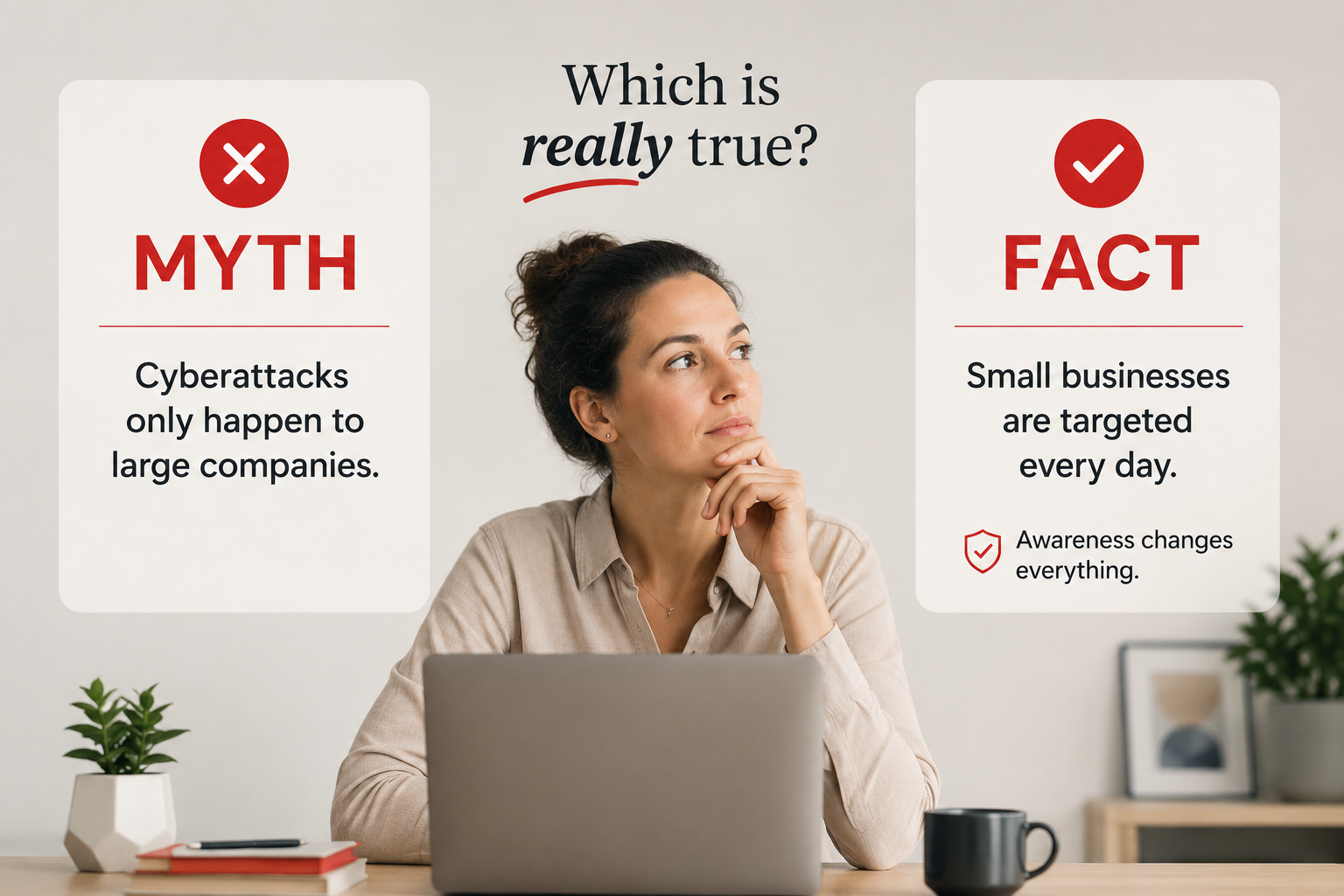
Myth 1: "We're too small to be a target."
This is the most common and the most dangerous, so it goes first. The thinking is that criminals chase big companies with big money, and a small business simply is not worth their attention.
The truth is the opposite. The large majority of attacks are automated, sweeping across thousands of businesses at once, hunting for whoever is easiest to get into. Small businesses are the easiest, precisely because they assume no one is looking and protect themselves the least. You are not flying under the radar. You are the low-hanging fruit the automated tools are built to find. Being small does not make you invisible. It makes you attractive.
What to do instead: accept that you are a target like everyone else, and put the basic protections in place that move you out of the easy-pickings pile.
Myth 2: "We have antivirus, so we're covered."
Antivirus feels like a finish line. You installed it, so the security box is checked, right?
The truth is that antivirus is one lock on one door of a building with many doors. It was designed mainly to catch known viruses, and today's threats are far broader: phishing emails, stolen passwords, ransomware, scams that trick people rather than infecting machines. Relying on antivirus alone is like locking your front door while leaving the windows wide open. It helps, but it is nowhere near the whole job.
What to do instead: treat antivirus as one layer among several. Real protection includes strong logins and multi-factor authentication, email security, backups, updates, and ideally someone monitoring for trouble.
Myth 3: "My IT person handles all that."
This one feels safe because it sounds responsible. You have someone for technology, so surely security is covered.
The truth is that IT and security are related but genuinely different jobs. IT keeps things running, sets up computers, fixes what breaks, keeps the email flowing. Security is about actively defending against people trying to get in, monitoring for threats, and responding when something happens. A capable IT person may handle some security basics, but assuming "IT has it" without confirming what is actually being done is exactly how gaps go unnoticed. We even wrote a whole piece on the difference, because it trips up so many owners.
What to do instead: ask plainly what is actually being done for security, specifically. If the answer is fuzzy, that is a gap worth closing, not a reason to panic.
Myth 4: "Cybersecurity is too expensive for a business like mine."
The belief here is that real protection requires an enterprise budget, so it is out of reach and not worth pricing out.
The truth is that some of the most powerful protections are free or nearly free, multi-factor authentication, software updates, strong password habits, team awareness, and that managed protection for small businesses is far more affordable than most owners assume. Meanwhile, the thing you are avoiding the cost of, a breach, averages well into the hundreds of thousands of dollars and ends a meaningful share of the businesses it hits. The real math is not "expensive protection versus free inaction." It is "modest, predictable cost versus a potentially business-ending one."
What to do instead: start with the free foundation today, and get an honest price for managed protection before assuming it is out of reach. You will likely find it costs far less than you feared.
Myth 5: "It won't happen to me."
This is the quiet one underneath all the others, the simple human sense that bad things happen to other people.
The truth is that this is not personal, which is exactly why "it won't happen to me" fails. To an automated attack, you are not a person it has decided to spare. You are an address among thousands being tested for weakness. The attacks do not care who you are, how careful you have been, or how good your intentions are. They care only whether your doors are open. Hoping you will be the exception is not a strategy, because the criminals are not choosing exceptions. They are scanning everyone.
What to do instead: replace hope with a few solid protections. You cannot control whether you are targeted, but you can control whether the attempt succeeds.
How we think about it
Notice the thread running through all five myths: each one is a reason to do nothing, and each one is wrong. That is what makes them dangerous. Seeing through them is genuinely half the battle, because once you do, the path forward is clear and manageable. That path is how we built Red Door Shield, around a simple framework we call KIT: Keep, Inspect, Trust. Keep what is valuable secure, Inspect what is coming in, and Trust through validation. It bundles the real protections these myths talk you out of into one affordable, coordinated system that runs in the background, so the truth is not just something you now understand, but something actually working for you.
What ready looks like
Picture making decisions about your business from the truth instead of from comfortable myths: knowing you are a target and being protected anyway, knowing antivirus is just one layer and having the others, knowing exactly what is being done for your security, knowing what it costs and that it is worth it, and knowing that "it won't happen to me" was never a plan. The stories that kept you exposed are gone, replaced by clear eyes and locked doors.
That is what ready feels like. Not believing the comfortable thing, but knowing the true thing and acting on it.
Every one of these myths is common because it is comfortable, and dangerous for the same reason. You do not have to fall for any of them anymore. If you want to see clearly where your business actually stands, beyond the myths, that is a conversation worth having today.
Learn why hackers target small businesses, read about the real cost of cybersecurity, or see the difference between IT and cybersecurity.
Know Where Your Business Stands
Our free Business Security Assessment gives you a clear picture of your current security posture in less than 10 minutes. No technical knowledge required.
Not sure where your business actually stands?
Take our free Business Security Assessment. In under 10 minutes, you will know exactly where your gaps are and what it would take to close them.
Get My Free Security Assessment