I ran an IT support company for seventeen years.
I say that at the start of this post because it matters for what comes next. I am not writing this to diminish what IT professionals do. I am writing it because I watched this confusion play out in real businesses over nearly two decades, and I know exactly what it costs when a business owner believes that having IT support means their cybersecurity is handled.
It does not. And understanding why is one of the most valuable things a small business owner can do for the long-term protection of their business.
Why the Confusion Exists
The confusion between IT support and cybersecurity is understandable. Both involve technology. Both are typically handled by people with technical backgrounds. Both are often managed by the same person or the same company for a small business. And for a long time, the overlap was significant enough that the distinction did not matter as much as it does today.
That changed as the threat environment changed. A decade ago, a skilled IT professional who kept your systems updated, maintained your antivirus software, and responded quickly when something went wrong was providing most of the protection a small business realistically needed. The attacks targeting small businesses were less sophisticated, less automated, and less frequent.
Today, the attacks are different. They are AI-powered, they are automated at a scale no manual response can match, and they are specifically designed to bypass the tools that a general IT support function relies on. The gap between what IT support provides and what cybersecurity requires has grown from a crack to a canyon. And businesses that are not aware of that gap are falling through it regularly.
What IT Support Actually Is
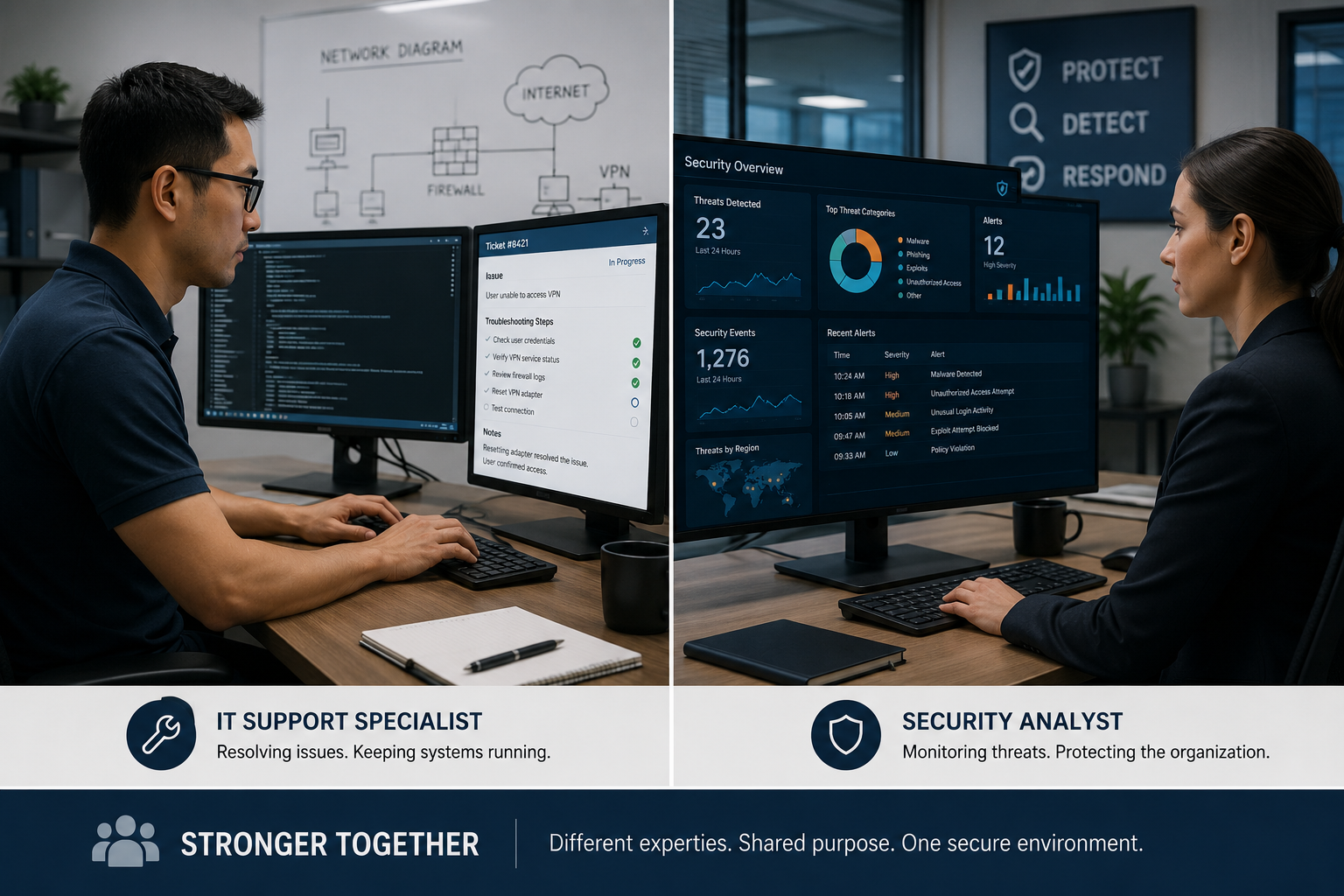
IT support is the practice of maintaining and repairing the technology infrastructure that keeps your business operational. It is, at its core, a functional service. It answers the question: is the technology working?
A competent IT support function keeps your computers running and connected. It manages your network infrastructure. It installs and updates software. It troubleshoots problems when hardware fails or systems behave unexpectedly. It sets up new devices when team members join and recovers data when something goes wrong with a machine. For businesses that rely on technology to operate, which is every business today, good IT support is genuinely essential.
The defining characteristic of IT support is that it is primarily reactive. Something stops working. The IT person fixes it. Something needs to be set up. The IT person sets it up. The measure of success is uptime and functionality. Is the business able to operate normally? If yes, IT support is doing its job.
IT professionals are skilled, dedicated people doing important work. The issue is not their capability. The issue is the scope of what IT support, as a function, is designed to address. And that scope does not include the active, continuous security work that the current threat environment requires.
What Cybersecurity Actually Is
Cybersecurity is the practice of protecting your business's digital environment from unauthorized access, attack, and compromise. It is, at its core, a security service. It answers a different question: is the technology safe?
A cybersecurity function does not primarily fix things that have broken. It works to ensure that specific categories of things do not break. It monitors your environment continuously for signs of unauthorized access or unusual behavior. It evaluates the threats your business faces and implements controls specifically designed to address those threats. It detects attacks in progress and responds to contain them before they cause maximum damage. It plans for the scenarios where something does get through and ensures recovery is possible.
The defining characteristic of cybersecurity is that it is primarily proactive. It operates whether or not anything appears to be wrong, because the most dangerous situations are the ones that appear normal while an attack is already underway. The measure of success in cybersecurity is not whether systems are working. It is whether systems are protected against the threats that exist right now, including threats that have not yet been detected.
This distinction, reactive versus proactive, functional versus secure, is the core of what separates the two disciplines. A business can have perfectly functioning technology that is completely unprotected. Both statements can be simultaneously true. In fact, that is exactly the situation most small businesses are in when they have IT support but no cybersecurity.
The Specific Gap Between the Two
The gap between IT support and cybersecurity becomes most visible in three specific areas.
Threat monitoring
IT support responds to problems that are reported to it. Cybersecurity looks for problems that have not been reported yet because the business does not know they exist. The average data breach goes undetected for weeks in small business environments because no one is actively watching the behavioral signals that indicate unauthorized access. An IT support function is not designed to watch for those signals. A security operations function is.
Attack detection and response
When ransomware executes across a small business network, the IT support person's role begins after the damage has been done. They restore from backups if backups exist and are intact. They rebuild what can be rebuilt. Cybersecurity's role, operating through continuous behavioral monitoring and endpoint detection and response technology, is to identify the attack during the pre-deployment phase, before the encryption executes. The difference in outcome between those two scenarios is the difference between a contained incident and a catastrophic one.
Security posture management
IT support keeps your current systems running. Cybersecurity evaluates whether your current systems are adequately protected against current threats and recommends changes when they are not. Multi-factor authentication requirements, access control audits, email security configuration, incident response planning, compliance documentation, and regular security assessments are all within the scope of a security function and outside the typical scope of IT support.
What This Looks Like in Real Businesses
Both the Chicago accounting firm and the HVAC company covered in earlier posts in this series had IT support when they were breached. Their IT person had set up antivirus software, maintained their network, and was responsive when they called with problems. By every normal measure, their technology was being managed.
Neither business had cybersecurity. No one was monitoring their environment for the behavioral signals that preceded the attack. No one had implemented the specific controls that would have stopped the phishing email from executing, detected the lateral movement during the dwell period, or isolated the affected systems before the encryption deployed.
The IT support function was doing exactly what it was designed to do. The security function that was not present was the one that would have made the difference.
This is not a criticism of the IT professionals involved. It is a description of the scope mismatch. As we covered in The 5 Lies Small Business Owners Believe About Cybersecurity, asking your IT support person to provide enterprise-grade cybersecurity is like asking your general practitioner to perform specialized surgery. The general practitioner is a skilled professional providing genuinely valuable care. The surgery requires a different specialist with different training and different tools.
What a Business With Both Looks Like
A business that has both IT support and cybersecurity in place operates with two distinct but complementary functions.
The IT support function keeps the business running. New computers get set up. Network issues get resolved. Software gets updated. When a team member has a technical problem, someone answers the phone and fixes it.
The cybersecurity function keeps the business protected. Endpoints are monitored continuously for behavioral anomalies. Email is filtered before it reaches anyone's inbox. Authentication controls verify that users are who they say they are. Access is limited to what each person actually needs. Backups are tested and immutable. A response plan exists before a response is needed. And a security operations team is watching the environment around the clock for the signals that indicate something is wrong.
Neither function replaces the other. A business without IT support that has excellent cybersecurity still cannot function when a computer fails or a network goes down. A business with excellent IT support but no cybersecurity runs smoothly right up until the moment it does not, and that moment is increasingly likely for every small business operating in today's threat environment.
How to Evaluate What Your Business Actually Has
Before assuming your current setup covers both functions, ask your IT contact the following specific questions.
Ask whether you have endpoint detection and response technology on every device, or only traditional antivirus software. These are different things, and the distinction matters significantly.
Ask whether anyone is actively monitoring your network for unusual behavior around the clock, or whether alerts are reviewed periodically during business hours. Continuous monitoring and scheduled review are not the same protection.
Ask whether your email has dedicated security filtering beyond your platform's built-in spam filter, including link analysis and attachment sandboxing.
Ask whether you have a documented incident response plan that includes specific steps for the first 24 hours of a breach, including notification obligations under Illinois law.
Ask whether your backup systems have been tested recently, whether any backups are stored in an environment isolated from your primary network, and whether any backups are protected against deletion or modification.
If the answers to these questions are unclear, incomplete, or reveal gaps, you have your answer about the state of your current cybersecurity posture. IT support and cybersecurity are both in place and working when you can answer each of those questions with specificity and confidence.
How the KIT Framework Addresses This Distinction
Red Door Shield was built specifically to fill the cybersecurity gap that IT support leaves open for small businesses.
The Keep layer implements the security controls that protect your environment, including endpoint detection and response, multi-factor authentication, and access controls. The Inspect layer provides the continuous monitoring that identifies threats before they cause maximum damage, including the around-the-clock security operations coverage that watches for behavioral signals an IT support function was never designed to look for. The Trust layer ensures that every user and device accessing your systems is continuously verified rather than assumed to be legitimate based on past access.
KIT works alongside your existing IT support function rather than replacing it. The IT person continues maintaining your technology. Red Door Shield handles the security function that IT support was never designed to provide. The gap closes. Both functions are in place. The business runs and is protected simultaneously.
Not sure where your business actually stands?
Take our free Business Security Assessment. In under 10 minutes, you will know exactly where your gaps are and what it would take to close them.
Get My Free Security Assessment