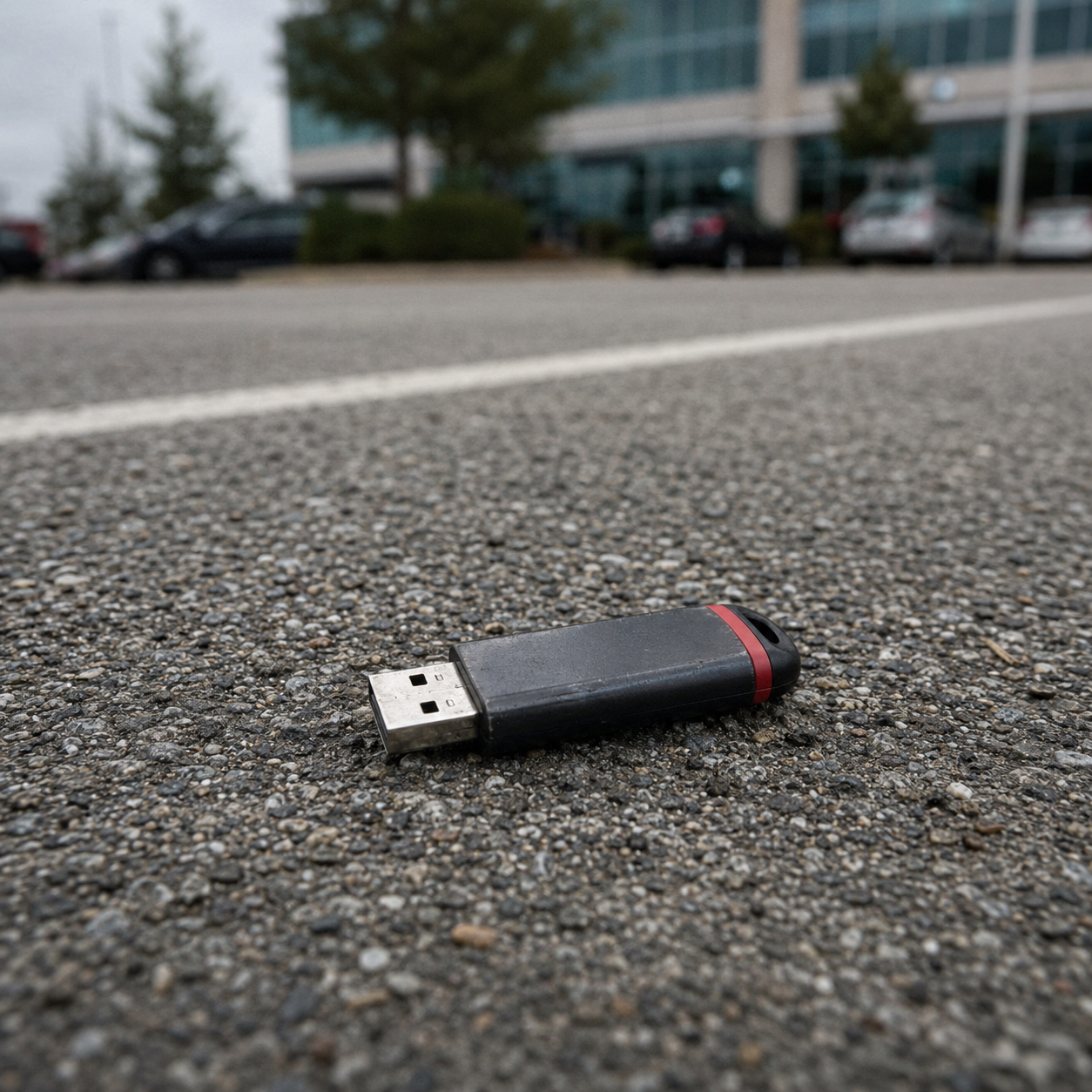
Picture this. An employee walks across the parking lot and spots a USB flash drive lying on the ground near the entrance. No label, or maybe one that says something intriguing like "Payroll" or "Confidential." What do they do? For a surprising number of people, the answer is: pick it up, take it inside, and plug it into a computer, either out of curiosity or a genuine wish to find and return it to its owner. And in that small, well-meaning moment, they may have just handed a criminal the keys to your business.
This is one of the oldest tricks in the book, and it still works beautifully, because it exploits something no software can patch: human curiosity. It is called a baiting attack, and while it sounds almost too simple to be dangerous, a single found or free USB drive can compromise a machine in seconds. Here is how it works and the dead-simple rule that shuts it down.
How the free USB trick works
The concept is elegant in its simplicity. Rather than trying to hack their way in from the outside, a criminal lets you carry the threat inside for them. They leave malicious USB drives where your employees will find them, a parking lot, a lobby, a sidewalk near your office, sometimes labeled to spark curiosity, and they wait. They know that human nature will do the rest, because people find it hard to resist plugging in a mystery drive, especially one that hints at something interesting or one they want to return to its rightful owner.
The moment someone plugs that drive into a work computer, the trap can spring. A malicious USB device can automatically run harmful software, install a hidden backdoor that gives the criminal access, or even pretend to be a keyboard and rapidly type commands that compromise the machine, all in a matter of seconds, often with nothing visible happening on screen. The employee thinks they simply checked an empty drive. In reality, they may have just opened a door into your entire network.
And it is not only drives found on the ground. The same risk applies to free USB drives handed out as promotional gifts, conference swag, or "free samples." A USB drive given away by an unknown source can be tampered with just as easily as one dropped in a parking lot. The word "free" and the friendly context lower people's guard, which is exactly the point.
Why it works so well
This trick endures because it targets good, normal human instincts. Curiosity is powerful, and a mystery drive practically begs to be explored. Helpfulness works against us too, because a well-meaning person wants to find the owner of a lost drive and return it, and plugging it in feels like the way to do that. And trust in a "gift" makes a free promotional drive feel harmless. The criminal is not defeating your technology. They are borrowing your team's decency and curiosity and turning them into the delivery method.
That is what makes this a people problem more than a technology problem, and it is why the defense is a simple rule rather than a piece of software.
The rule: unknown devices never get plugged in
Here is the whole defense, and it is refreshingly clear: no unknown USB drive or device ever gets plugged into a business computer. Not one found on the ground, not one received as a free gift, not one from any source you do not fully trust. Ever. Make it a firm, plainly stated office rule.
In practice, that means a few things for your team. If someone finds a USB drive, they do not plug it in to see what is on it or to find the owner. Instead, they hand it to management or whoever handles your technology, or simply discard it. Turning in a found device is the right move, not investigating it yourself. Be equally cautious with free promotional drives from events or unknown sources, and when in doubt, do not use it. The same wariness extends to other unknown devices and even unfamiliar charging cables and public charging stations, which can carry their own risks, a cousin of the connected-device caution we cover in smart device security.
For businesses that want an extra layer, the technology can help enforce the habit, since it is possible to configure computers to limit or block unknown USB devices and to disable the automatic-run behavior these attacks rely on. But the foundation is the rule and the awareness behind it.
It comes back to culture
This threat is a perfect example of why a security-aware team is one of your strongest protections. No firewall stops an employee from plugging in a drive they found. Only a shared understanding does. So the real defense is making sure everyone knows this trick exists and knows the rule, and feels good about following it rather than embarrassed to "waste" a found drive. That kind of everyday awareness is exactly what we mean by building a security culture, where people naturally do the safe thing because they understand why.
Tell your team the story of the parking lot drive. It sticks, and a team that has heard it is far less likely to fall for it.
How we think about it
The free USB trick is social engineering in its purest, simplest form, which is why it fits so clearly into how we think about security at Red Door Shield, through a simple framework we call KIT: Keep, Inspect, Trust. Keep what is valuable secure, including configuring devices to resist unknown USB hardware where it makes sense. Inspect what is coming in, with the monitoring and device protection that can catch what a bad drive tries to do. And trust through validation, which here is beautifully literal: you do not trust an unknown device just because it is in your hand, you refuse to plug it in at all. We help businesses put both the technical controls and the team awareness in place, so a dropped drive stays exactly what it should be: a piece of junk on the pavement.
What ready looks like
Picture the mystery USB drive appearing in your world, in the parking lot, in a swag bag, wherever, and instead of getting plugged in, it gets handed to management or tossed, because everyone on your team knows the rule and the reason behind it. The criminal's patient little trap earns them nothing, because your people carried nothing inside. A threat that relies entirely on curiosity meets a team that knows better.
That is what ready feels like against the oldest trick in the book. Not hoping no one gives in to curiosity, but having a clear rule that makes curiosity harmless.
The free USB drive works because it is simple and human, and it will keep working on businesses that never think about it. Yours does not have to be one of them. One clear rule, unknown devices never get plugged in, plus a team that knows the story, closes the door completely. If you want help putting the awareness and the technical protections that back it up in place across your business, our free Business Security Assessment is the place to start, and it is a conversation worth having today.
Know Where Your Business Stands
Our free Business Security Assessment gives you a clear, professional picture of your current security posture in less than 10 minutes. No technical knowledge required.
Not sure where your business actually stands?
Take our free Business Security Assessment. In under 10 minutes, you will know exactly where your gaps are and what it would take to close them.
Get My Free Security Assessment