When people think about the scariest cyber threats, they picture ransomware: the locked screens, the ominous payment demands. It makes for dramatic headlines. But here is a fact that surprises almost every business owner. There is a quieter scam that costs businesses far more money than ransomware, year after year, and most owners have never even heard its name. It is called business email compromise, and by the FBI's own numbers, it is one of the most financially destructive crimes aimed at businesses in the country.
Understanding this scam is genuinely one of the most valuable things a business owner can do, because it is common, it is devastating, and it is highly preventable once you know how it works. So let me give you the plain-English explanation: what business email compromise actually is, why it costs so much, the three most common versions you are likely to encounter, and how to protect your business from all of them.
What business email compromise actually is
Business email compromise, often shortened to BEC, is a scam where a criminal uses email to trick a business into sending money or sensitive information to the wrong place, by pretending to be someone the business trusts. That is the whole thing in one sentence. There is no dramatic hacking of your systems in the movie sense. The criminal either breaks into a real email account or convincingly imitates one, and then uses that trusted identity to request a payment, a change of banking details, or confidential information.
What makes BEC different from a clumsy spam email is the care behind it. These are targeted, researched, and patient attacks. Often the criminal has quietly gained access to a real email account, an owner's, an employee's, a vendor's, and spent days or weeks reading the messages there, learning who pays whom, how people talk, what deals are in progress, and when money moves. Then, armed with all that context, they strike at exactly the right moment with a request that looks completely legitimate. It is fraud dressed in the clothing of a normal business email, which is precisely why it works.
Why it costs more than ransomware
Here is where the numbers tell a story most owners find genuinely shocking. According to the FBI's Internet Crime Complaint Center, business email compromise consistently ranks among the very costliest cybercrimes against businesses, and in reported dollar losses it dwarfs ransomware. In the FBI's 2025 report, BEC accounted for roughly three billion dollars in reported losses, while ransomware accounted for a small fraction of that by comparison. Over recent years, BEC has drained billions from businesses, making it one of the single largest sources of cyber-related financial loss there is.
Why does a scam most people have never heard of cost so much more than the one everyone fears? A few reasons. BEC targets money directly, the payment, the wire, the transfer, rather than taking a detour through locked files and a ransom demand. It often succeeds quietly, with no alarm to interrupt it, so the money is gone before anyone notices. The amounts can be large, because these attacks are aimed at real transactions, sometimes very big ones. And once a payment is wired to a criminal, it is usually gone for good, with little chance of recovery. Ransomware is louder and scarier, but BEC is quietly, steadily more expensive. The scam that gets the headlines is not the scam doing the most damage.
A real example: Janet's story
To see how this actually plays out, consider the kind of case that repeats itself in businesses everywhere. We have told Janet's story elsewhere on this blog, and it is worth revisiting here as the human face of these numbers. Janet ran a commercial cleaning business, a solid, ordinary company. A criminal quietly compromised her email and sat inside it for weeks, silently reading, learning the rhythm of her business, while everything on the surface looked perfectly normal. No sirens, no warnings. Then, at the right moment, the attacker used what they had learned to redirect funds, and by the time anyone realized what had happened, thousands of dollars were gone, and months of rebuilding trust lay ahead.
Janet's experience is business email compromise in its purest form: patient, silent, and devastating precisely because nothing seemed wrong until the money had already left. Her story is not unusual. It is the everyday reality behind those billions in losses, playing out one ordinary business at a time.
The three most common versions
Business email compromise takes a few predictable forms. Knowing them by name is a real defense, because recognizing the pattern is most of what stops it.
1. The fake invoice
This is one of the most common versions, and it often targets businesses that work with vendors and suppliers. The criminal, having accessed or imitated a vendor's email, sends an invoice or a message about payment that looks entirely legitimate, except the banking details have been changed to the criminal's account. Your business pays the invoice as usual, and the money goes to the thief instead of the real vendor. The invoice looked right, the vendor was real, and only the account number was wrong. This is the version that hits contractors, property managers, and any business that regularly pays suppliers.
2. Executive impersonation (CEO fraud)
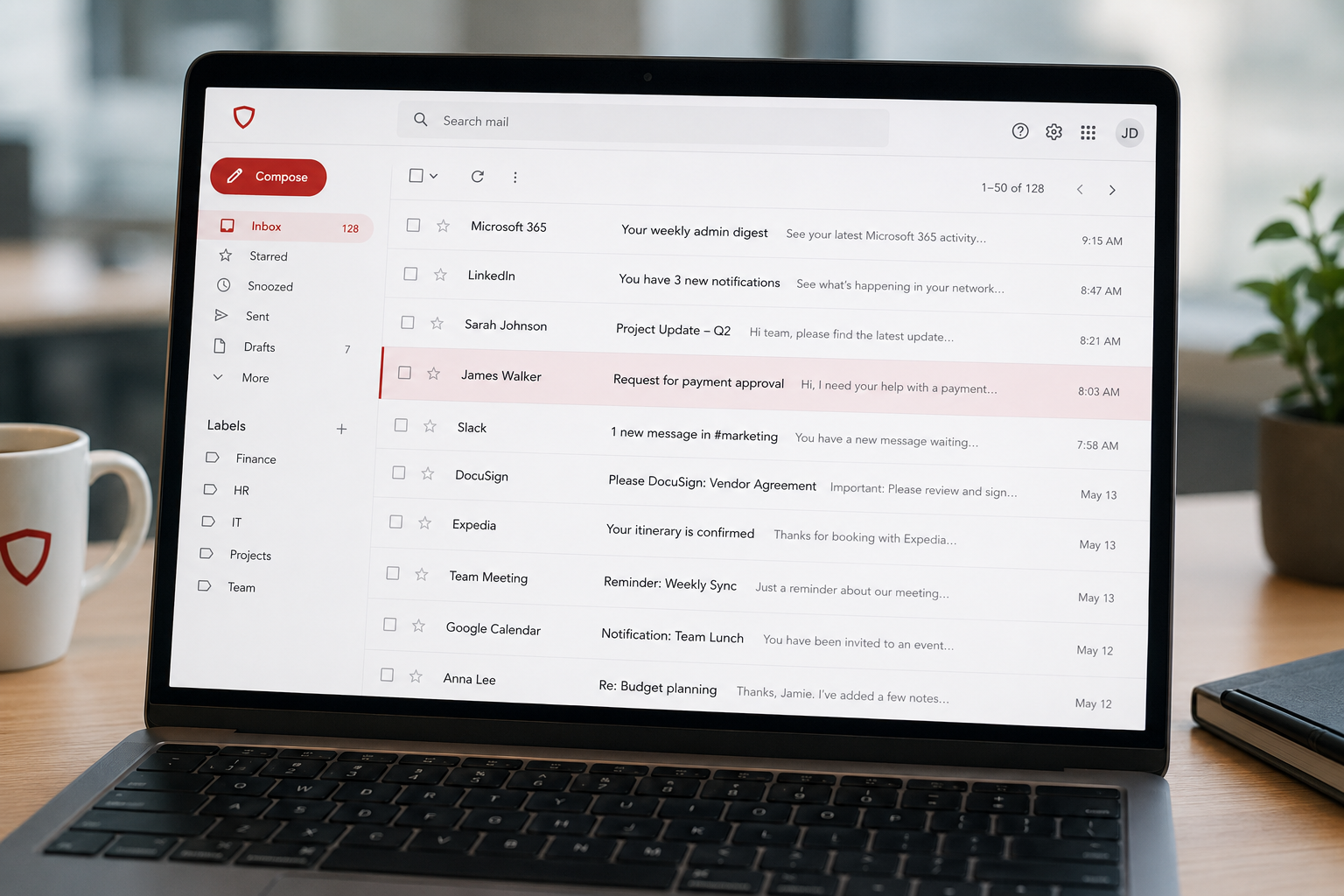
In this version, the criminal impersonates an owner, executive, or manager, often by imitating their name in an email or by having compromised their actual account, and sends an urgent request to an employee, typically in finance or accounting. The message asks them to make a payment, send a wire, or buy gift cards quickly, playing on the employee's desire to be responsive to the boss. Because it appears to come from someone in authority and carries urgency, the employee acts without the usual scrutiny. This is often called CEO fraud, and it is why a rushed "handle this for me" message from the top deserves extra caution, not less.
3. The payroll or banking change
Here the criminal impersonates an employee, often by email, and requests that their payroll direct deposit or banking information be updated to a new account, which belongs to the criminal. The next payroll run sends that employee's pay straight to the thief. The same trick applies to changing a vendor's or a customer's payment details. Any request to change where money is sent is a prime BEC opportunity, and deserves to be treated as one.
Across all three, notice the common thread: a trusted identity, a request involving money or payment details, and a reason to act quickly. That pattern is the signature of business email compromise.
How to protect your business from BEC
The encouraging news, given how costly this scam is, is that it is highly preventable, and the single most powerful defense costs nothing at all.
That defense is a simple, ironclad rule: any request to send money, change banking or payment details, or update payroll information is always verified through a separate, known channel before anyone acts. In practice, that means a phone call to a number you already have, not one from the email, to confirm the request is real. This one habit defeats the overwhelming majority of BEC attacks, because the scam depends entirely on you trusting the email without checking. Take away that unchecked trust, and the whole thing collapses. A real request survives a thirty-second verification call. A fraudulent one does not.
Beyond that rule, a few protections close the door further. Multi-factor authentication on your email accounts makes it far harder for a criminal to break in and lurk in the first place, which cuts off these attacks at the source. Email security helps filter out the impersonation attempts and lookalike domains before they reach an inbox. And team awareness matters enormously, because everyone who handles payments needs to know this scam exists, recognize the pattern, and feel empowered to slow down and verify, especially when a request is urgent or comes from the top. Together, these turn business email compromise from a serious threat into one your business is genuinely equipped to stop.
How we think about it
Because business email compromise is both the costliest and one of the most preventable threats businesses face, defending against it is central to how we think at Red Door Shield, through a simple framework we call KIT: Keep, Inspect, Trust. Keep what is valuable secure, with multi-factor authentication that keeps criminals out of the email accounts these scams depend on. Inspect what is coming in, with the email protection and monitoring that catch impersonation attempts and the signs of a compromised account, ideally during the quiet weeks before the payoff. And trust through validation, which is the very heart of stopping BEC: you verify a payment or banking request through a known channel rather than trusting the email in front of you. The scam runs entirely on misplaced trust. Validation is how you take that fuel away.
What ready looks like
Picture a perfectly convincing email arriving, a familiar vendor with updated banking details, or an urgent request that looks like it came from you, and instead of a payment going out, it gets a quick verifying phone call that exposes the fraud in seconds. Your email accounts are locked down so a criminal cannot easily get inside to watch and wait. Your team knows the pattern and knows the rule. The scam that quietly drains billions from other businesses arrives at yours and simply fails.
That is what ready feels like against the costliest threat most owners have never heard of. Not hoping you would spot a flawless fake, but having a rule and protections that make spotting it unnecessary.
Business email compromise is the quiet, expensive scam that too few owners know by name, and now you are not one of them. It is common, it is devastating, and it is genuinely preventable with one firm habit and a few solid protections. If you want to know whether your business is protected against BEC and the other threats aimed at your money, that is exactly what our free Business Security Assessment is for, and it is a conversation worth having today, before the convincing email arrives.
Not sure where your business actually stands?
Take our free Business Security Assessment. In under 10 minutes, you will know exactly where your gaps are and what it would take to close them.
Get My Free Security Assessment