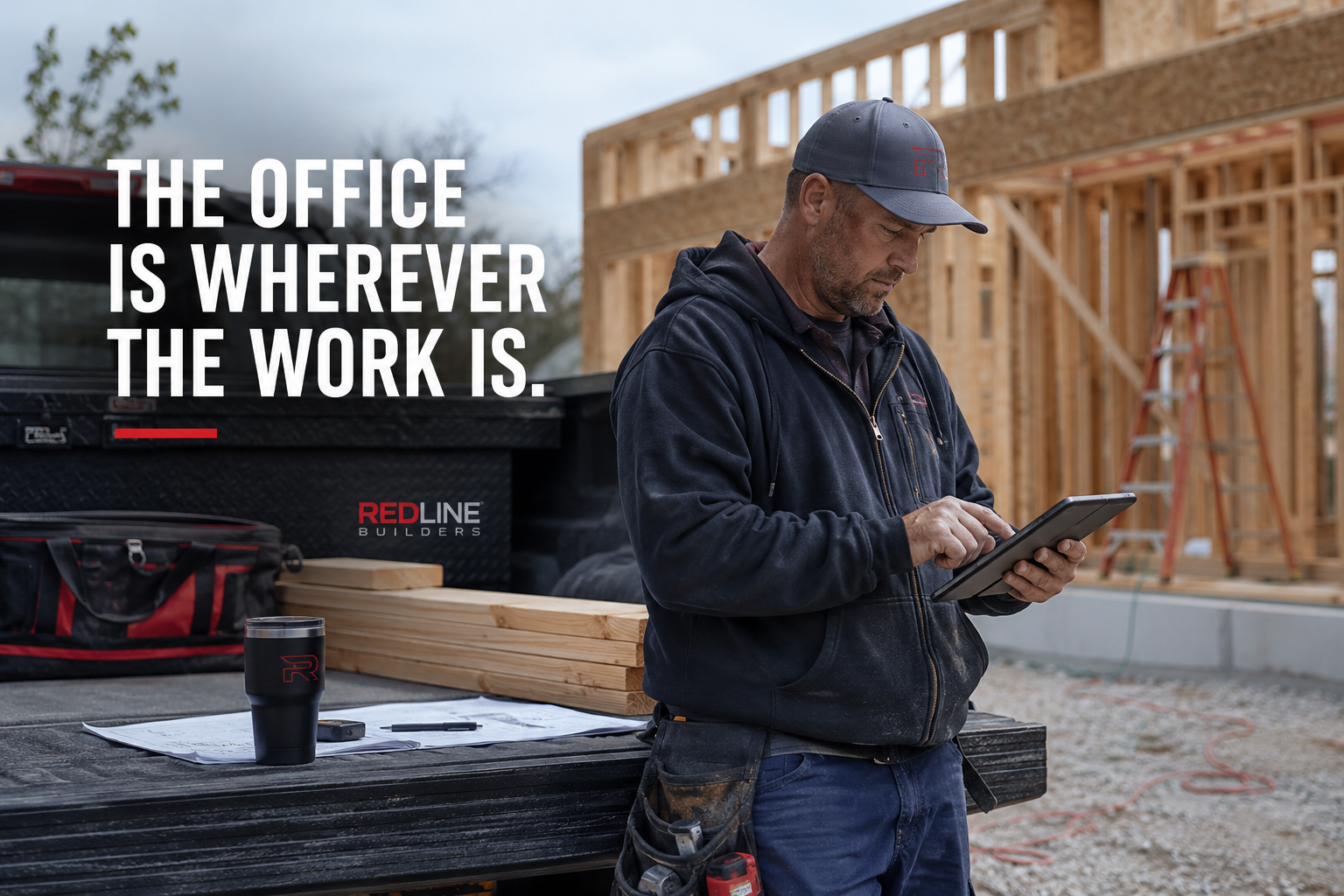
Most cybersecurity advice quietly assumes you sit at a desk in an office all day. For a contractor, that assumption is almost comically wrong. Your business does not live in one building. It lives in trucks, on jobsites, on the phone in your pocket, and in a dozen apps your crew uses from wherever the work is. The estimate gets sent from a parking lot. The invoice goes out from the cab of a truck. The plans get pulled up on a tablet in a half-built room with the framing still exposed.
That mobility is the strength of the business. It is also the part that makes its cyber risk different from almost any other industry. When your operation runs everywhere, your security has to run everywhere too, and for most contractors it does not. Let me walk through why that matters and what to do about it, in plain terms, because protecting a mobile business is very doable once you see where the gaps are.
Why the field changes everything
In a traditional office, there is a perimeter. The computers sit behind one network, inside one building, with one set of doors to lock. A contractor has no such perimeter. The "office" is wherever your people happen to be, which scatters the risk across every device and every connection your crew uses.
Think about what that means in practice. Phones and tablets travel to every jobsite and get left in trucks, dropped on concrete, and occasionally lost or stolen, often with email, customer information, and app logins still on them. Crews connect to whatever Wi-Fi is available, sometimes open networks at a supply store or a client's site, where information can be intercepted. Business runs heavily over text and phone, which is exactly where a newer wave of scams now lives, because people trust a text more than they question it. And the same person is often the owner, the estimator, the dispatcher, and the bookkeeper, doing all of it from a phone between jobs, with no IT department anywhere in sight.
None of this is a flaw in how you run things. It is the nature of the work. But it means the doors an attacker can try are spread across every device and connection your business touches, not tucked safely inside one office.
What is actually at risk
It helps to be concrete about what a contractor stands to lose, because it goes well beyond the obvious.
There is the money in motion, which we have written about before: the payment redirection and fake invoice scams that hit construction hard because large payments move between owners, subs, and suppliers, often coordinated by email. That remains the most common and costly attack in this industry.
There is the project data itself. Bids, plans, contracts, and client information have real value. A competitor advantage can leak. Client trust can break if their information is exposed. And a bid you spent days preparing is not something you want sitting unprotected on a lost tablet.
And there is the one contractors feel most immediately: downtime. If ransomware locks your scheduling, your estimates, or your accounting, the business does not just lose data, it stops. Crews show up with nothing to do. Jobs slip. Clients who were promised a date get an excuse instead. In a business where reputation travels by word of mouth and the schedule is everything, a few days of being unable to operate can do more damage than the attack itself.
What protection looks like for a mobile operation
The good news is that protecting a business that runs in the field does not require an office or an IT team. It requires the protection to travel with the work.
It starts with securing the devices, because for you the device is the office. Multi-factor authentication, the extra code sent to your phone, on email and your key apps, so a lost or stolen phone does not hand someone the keys to the business. Strong screen locks on every device. The ability to remotely wipe a phone or tablet that goes missing. And modern protection on those devices that watches for threats wherever they connect, not just on an office network.
It includes being deliberate about connections, so crews are not routinely sending sensitive information over open public Wi-Fi without protection. It includes treating text-message and phone requests with the same caution as email, especially anything about payments or account changes, and confirming those through a known channel before acting. It includes reliable, tested backups of your scheduling, estimates, and accounting, so that if something does lock you up, you can be back to work quickly instead of stuck. And it includes a simple plan for what to do if a device is lost or an account is compromised, so a bad moment is handled, not improvised.
How we think about it
This is exactly the kind of protection we built Red Door Shield to provide, organized around a simple framework we call KIT: Keep, Inspect, Trust. Keep what is valuable secure, which for a contractor means the devices, the project data, and the backups that keep you running. Inspect what is coming in, which means monitoring that travels with your team instead of guarding an office you are rarely in. And trust through validation, which means verifying payment and account requests rather than trusting a convincing text or email. The whole point is protection that works the way you work, in the field, on the move, without adding a job to your already full plate.
What ready looks like
Picture a crew member losing a phone on a jobsite and it being a shrug instead of a crisis, because the device is locked, the data is protected, and it can be wiped remotely. Picture a "change our payment details" text arriving and your team confirming it with a quick call before anything moves. Picture ransomware hitting and your scheduling and estimates coming right back from a tested backup, so the crews work and the jobs stay on track.
That is what ready feels like. Not hoping nothing goes wrong out in the field, but knowing your protection goes wherever the work goes.
You built a business that runs anywhere, on time, and on your word. Protecting it has to be just as mobile and just as reliable. If you want to know where your operation is exposed, across the phones, tablets, and tools your business actually runs on, that is a conversation worth having before a lost device or a locked system makes the decision for you.
Read more about contractor payment fraud, review our 8-point cybersecurity checklist, or learn about cyber insurance requirements.
Know Where Your Business Stands
Our free Business Security Assessment gives you a clear picture of your current security posture in less than 10 minutes. No technical knowledge required. No jargon. Just honest answers.
Not sure where your business actually stands?
Take our free Business Security Assessment. In under 10 minutes, you will know exactly where your gaps are and what it would take to close them.
Get My Free Security Assessment